Marine Transportation System

Archive for the ‘Infrastructure’ Category

Obama Jobs Initiative: Meaning in Missing Words?

In Infrastructure, Ports on December 8, 2009 at 4:19 pm

This is what is in the president’s jobs proposal announced today with respect to infrastructure investment:

2. Investing in America’s Roads, Bridges and Infrastructure

Additional investment in highways, transit, rail, aviation and water. The President is calling for new investments in a wide range of infrastructure, designed to get out the door as quickly as possible while continuing a sustained effort at creating jobs and improving America’s productivity.

Support for merit-based infrastructure investment that leverages federal dollars. The Administration supports financing infrastructure investments in new ways, allowing projects to be selected on merit and leveraging money with a combination of grants and loans as was done through the Recovery Act’s TIGER program.

The second paragraph is a reference to the over-subscribed TIGER grant program for which a broad range of transportation projects are eligible and awardees will be announced no later than February.  The administration has shown an affinity for “merit-based” grants (as opposed to congressional earmarks and formula funding).   USDOT loves it because it puts the Secretary in the position to judge what projects are worth funding and to apply White House principles such as emission reduction.

With so little in the way of detail we might infer from the first paragraph that the Marine Transportation System may not be as much as part of the next jobs bill as it was in ARRA signed in February.  Does the Obama administration include port or marine transportation as eligible for job stimulus funding?  Especially for  the “out the door” quickly category?

Certainly connecting roads and rail are valuable elements of the MTS but when the president’s proposal for infrastructure funding uses the term “water” it may not mean maritime.  I think it means water and sewer infrastructure, which would appeal greatly to capital starved municipal governments but do little for marine highway and other MTS infrastructure needs.

Prior references by Congress and the administration to funding maritime related projects as part of ARRA used the word “port“ along with rail, highway and transit projects.  No mention of port or maritime in the White House statement or the president’s remarks at the Brookings Institution today.

That said, port/maritime projects were eligible for TIGER grants, which the White House appears to want to continue.  But almost by definition TIGER grant money doesn’t flow in a matter of couple months.  The first grant announcements won’t be made until close to a year after the funds were appropriated by Congress in February 2009.  Indeed, I’m told that White House officials said after the president’s remarks that some part of the infrastructure element of the s announcement today may not be intended to pour money into the system over the short term.

The White released an outline today.   The administration and Congress will put flesh on the bones and maybe once the House and Senate take up legislation early next year ports and  marine transportation, including capital needs for marine highway development, will be eligible.

For that to happen, the industry will have to make its case.     Pbea

The Connective Tissue of a Nation

In Federal Government, Infrastructure on November 17, 2009 at 4:13 pm

You can’t thrive as a nation while New Orleans is drowning…and cities in upstate New York and the Rust Belt are rotting from lack of employment opportunities, and so on.   Imagine, instead, an America with rebuilt, healthy, dynamic metropolitan areas, and gleaming new port facilities, and networks of high-speed rail, an America with electric vehicles and a smart grid and energy generated by the power of the sun and wind and water and the ocean’s waves. (“What the Future May Hold”, November 17, 2009)

Bob Herbert of the New York Times has penned several columns about our crumbling infrastructure. How many times can writers like Herbert belabor the point?  Not enough.

Eugene Robinson of the WPost:  It’s unrealistic to think this disaster is going to spur the nation to seriously address all its infrastructure problems. We’ll talk about the issue for a while, then go out and buy another TV. But we can—and should—at least do a more rigorous inventory and identify the structures that pose the most peril. Yes, it’s boring stuff to even think about. But just look at the alternative. (“Back to Basics”, August 2, 2007)

David Brooks of the NYT:    In times like these, the best a sensible leader can do is to take the short-term panic and channel it into a program that is good on its own merits even if it does nothing to stimulate the economy over the next year. That’s why I’m hoping the next president takes the general resolve to spend gobs of money, and channels it into a National Mobility Project, a long-term investment in the country’s infrastructure. (“A National Mobility Project”, October 31, 2008)

Thomas Friedman of the NYT:  Look in the mirror: G.M. is us.  That’s why we don’t just need a bailout. We need a reboot. We need a build out. We need a buildup. We need a national makeover. That is why the next few months are among the most important in U.S. history. (“Time to Reboot America”, December 23, 2008)

Brooks and Friedman wrote on the eve of the new Administration and the writing of a stimulus bill by Congress.  Some small part of the “recovery” package  signed by the president was in the spirit of rebooting, as Friedman suggested, but it was too little.  The Obama Administration talked in vision terms but didn’t press for vision-scale action by Congress.

At this point–nearly a year into Democratic control of Washington and millions of  job losses later–an infrastructure policy is being talked about only in oblique terms, as “Stimulus II” or, by those who are fearful of  the spender label, the non-stimulus stimulus.  And as helpful as that may be for purposes of creating some jobs  it doesn’t substitute for an infrastructure policy.

So shall we primly, safely wait for Federal accounts to come into balance, saying we can’t afford it, while developing and developed nations on other continents propel themselves into economic vitality with steel, wind turbines, and fiber optics?  Consider what can be accomplished by putting money–yes, borrowed money–into real, decades-lasting, efficiency-producing, capacity-building, economy-stimulating, pride-inducing public works and critical infrastructure.

For all their faults the Civilian Conservation Corps and the Works Progress Administration of the 1930s strengthened our nation in lasting public works, a strong sense of conservation, and nation-building spirit.  As if to prod us into action some of the glorious thirties era infrastructure that has not been well maintained is visibly deteriorating.

Bob Herbert: Consider transportation. As Brookings tells us, “Other nations around the globe have continued to act on the calculus that state-of-the art transportation infrastructure — the connective tissue of a nation — is critical to moving goods, ideas and workers quickly and efficiently. In the United States, however, we seem to have forgotten.”

Pbea


Mapping the “Hidden Highway”

In Infrastructure, Marine Highway, New York Harbor on November 13, 2009 at 8:04 pm
NOS

Click for Audio

When someone talks about “keeping ships from turning into shipwrecks” we all probably could agree that’s a worthwhile use of tax dollars.

The fellow whose job it has been to map the coastal waters where ships ply the “hidden highway” is Captain Steve Barnum, who retired this year NOAA after 29 years.  He most recently headed NOAA’s Coast Survey, part of the National Ocean Service (NOS).

If you click the image above, you’ll hear him talk about the valuable service provided by the folks at NOS:

  • the country has “95,000 linear nautical miles of shoreline…3.4 square nautical miles of underwater territory” half of which was last mapped using “lead line soundings”…
  • mapping of the coastline is “a continual process”…many parts of the coastal regions remain uncharted…some data is as old as the Russian survey from when that country controlled Alaska
  • coastal surveys are also important for national security…military operations need accurate nautical charts…having a baseline makes it easier to reopen waterways after a national emergency
  • the MTS is the “hidden highway”…“hidden transportation system”
  • nautical charts are essential to the growth of the “efficient”  marine highway…making use of the “underutilized waterways” to get trucks off the road

The captain mistakenly refers to the Verrazano Bridge as an impediment for the increasingly larger ships–it’s the Bayonne Bridge, both being in the Port of New York-New Jersey–but he is right to highlight that commercial shipping is no different than other modes in needing adequate infrastructure and mapping.  In the case of  bridges, another NOS navigation system–PORTS–enables ship pilots to know the air draft under bridges in addition to better understanding available channel depth.  It’s just that when the highway is “hidden,” as the water routes are, it doesn’t get the attention–and the resources–that the dryways get.   Pbea

Next WRDA a Policy Bill?

In Infrastructure, Water Resources on November 3, 2009 at 3:29 pm

WRDAlite2

WRDA (say “wurr-da”) sometimes is an elusive, even mythical, thing.  When it appears out of the Capitol Hill mist–like Brigadoon–it’s not with the reliable–albeit once-in-a-hundred years–clockwork of that fabled village.   It is usually defined as a biennial water resources authorization bill but it rarely takes such predictable, finished form as a president might come to expect on his desk every two years…assuming he wants it there.

Part of WRDA lore (and lure) is that it is tailor made for end-of-congress action on the eve of congressional elections.  Before returning home Members would wrap up the bill and their press releases touting what WRDA holds for their districts.  For, above all, a Water Resources Development Act is a projects bill.  Indeed part of the legend–not without  good reason–is that for WRDA to get through Congress it must be laden with projects.  No projects, no critical mass.  No critical mass, not enough aye votes.

WRDA 2007, the most recent version made law, was propelled in part by the huge Everglades project.  It was not without controversy but as an environmental restoration project the Everglades project gave the bill essential critical mass and acceptability among many in the environmental community which often is critical of project bills.

Legislators submit their wish lists.  Even many Members who disdain the practice of earmarking.  Port channels.  Beach replenishment.  Flood control.  Environmental projects…these ever more so.  They include wastewater treatment, water supply and the like.

The foundation of any WRDA is projects that move “through the pipeline,” much as the Everglades restoration project did.  They are subjected to Federal feasibility and environmental studies and then Secretarial and White House review.  An interminable process to some.  Projects exit the pipeline, usually, as recommendations for formal authorization,  WRDA being the next step in a civil works project’s journey through government.

When it comes to critical mass, it looks as if WRDA 2010 could end up WRDA Lite.  Fewer projects and lower cost.  So far only a couple of projects have emerged from the pipeline.  Some folks suggest we may have more of a WRDA policy bill than a projects bill.  That’s possible.

As one example, ports have wanted the law changed to secure the Harbor Maintenance Trust Fund.   Harbor Maintenance Tax revenues go into the general treasury and only around 60 percent of the proceeds actually are spent on channel maintenance.   There’s meat for a WRDA.

We will have to see whether there will be sufficient oomph of any sort to power this next WRDA.  We may get a clue later this month.  The House Water Resources & Environment Subcommittee will hold its first WRDA hearing  on November 18th. Pbea

A Slice of Pie for Hungry Ports

In Infrastructure, Ports on October 13, 2009 at 11:25 pm

I’m not sure if this is a troubling sign but Sally Fields comes to mind when I think of TIGER grants.

Those are the multi-modal, discretionary grants that were created in the economic stimulus bill Congress approved last February.  The pleased folks at USDOT dubbed the program TIGER–a suitable acronym–and put flesh on the bones. Pleased because this was one of those rare times when Congress was willing to say: “Here, Mr. Secretary, is 1,500,000,000 dollars for you to spend, outside of existing modal grant programs, at your discretion.

There were some rules of course, but none of the earmarked projects Congress is so fond of TIGERpiedesignating to the fullest extent of available funds.

And with a reform-oriented SAFETEA-LU sequel due to be written by Congress it was not lost on USDOT that if the TIGER program were managed well–whatever “well” might mean to congressional overseers–it could be a model for replication.  USDOT may be entrusted to award more competitive grants on the basis of project merit and worth to the country.  Imagine that.  (Indeed, the Senate DOT appropriations bill for FY 2010 includes $1.1 Bn for additional TIGER grants.)

In the months that followed enactment of the $750 Bn stimulus package–some $48 Bn of which was allocated to USDOT for near term implementation–Secretary Ray LaHood told port officials and others involved in the MTS that port project applications would be welcomed for TIGER grants.  He told the D.C. Propeller Club audience in May that the maritime sector has been neglected and TIGER grants were an opportunity.

Well, the ports listened.  Shades of Sally Fields!  When in 1985 she won her second golden statue for her role in Places in the Heart the former “Flying Nun” famously cried, “You really like me!”

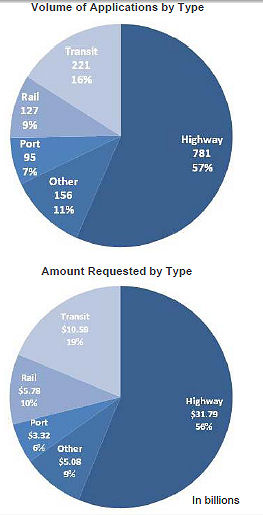
The ports took to heart the Secretary’s encouragement. He really wanted them to apply for grants and apply they did.  Ninety-five applications were submitted for port related projects totaling $3.3 Bn.  Certainly the smallest of the modal slices on the pie chart, but not an overwhelming difference when compared to rail.

Toward what end?  We’ll learn in February what projects are approved and how many are for ports.  The TIGER grants and pending legislation to grant MARAD infrastructure improvement authorities are signs that change may be in the wind.  The Feds are becoming more open to assisting ports with more than just channel construction and maintenance.  Certainly MARAD is eager to claim new program areas.  And some of the ports, perhaps an increasing number, are welcoming the help of Uncle Sam…maybe even inside the gate.   Pbea

Rendell Bets on a Delay

In Infrastructure, Surface Transportation Policy on September 25, 2009 at 7:44 am

Governor Ed Rendell, a leading figure in the call for infrastructure reform and investment in the U.S., said that any surface transportation bill that Congress could pass this year would be a “very mediocre bill in terms of the needs of the country.”

In a story yesterday by Bob Edmonson of the Journal of Commerce the governor acknowledged, “In one sense a delay is hurtful, but in another sense the delay would give us a chance to look at new ideas, and build new concepts, and try to get a bill that will really revolutionize.”  Rendell spoke at a American Road and Transportation Builders Association conference.

The governor apparently assumes that the Senate and Administration will succeed in getting an 18 month extension of  the expiring SAFETEA-LU.  Chairman Jim Oberstar (D-MN) on the House side doesn’t want to put off major revenue and policy decisions that long.

On September 23rd when the House debated, and passed, a three month extension, through December, Steven LaTourette (R-OH) agreed that action is needed now.  His House Republican leadership opted to object to a prospective gas tax hike, which was not even on the table, rather than identify themselves with the need to maintain highway and transit programs.  LaTourette stood in the well–exasperated, looking at his own party members–and said, “I am constantly amazed at how both parties are able to snatch defeat from the jaws of victory.”  He foresees his party in the months ahead fighting a major transportation bill in the cause for low taxes.

In a recession the desire to improve the economic environment for employment is genuine and politically vital.  It’s easy to understand the impatience.  Oberstar and others want to move as quickly as possible to produce a 5-year, $450 Bn transportation bill.   Then again, there is that knotty problem of how to pay for it, as noted in this prior posting.

Whatever other thinking may be behind Governor Rendell’s frank remarks to the “road builders” he makes an important point.  On the surface is this one:  Jim Oberstar may be ready to move a bill but the Senate and administration are not.  But Rendell seems to go deeper than that.  Crafting a major bill, with its inherently difficult revenue issues and bearing the weight of expectations that this one must break new policy ground, will take more time.

Rendell is right.  After reaching the pinnacle that is SAFETEA-LU we don’t need another “mediocre” bill.   The hearing record of recent years is loaded with testimony calling on Congress to not repeat past mistakes and, as the governor put it, to produce “a bill that will really revolutionize.”  Freight policy, high-speed rail, transportation policy in a new energy/environment policy framework, performance measures, marine highways, livable communities, and the broader question raised by the Secretary as to how to integrate the MTS more fully into surface transportation policy.  These are just some of the policy challenges.

The Oberstar bill is a clear step in that direction.  And while the Senate committees have been plotting their TEA contributions the administration can’t say the same.  The White House and the Department of Transportation, which remains immersed in implementing the economic stimulus package with its multi-billion dollar new programs,  are nowhere near ready to be a full participant in the crucial dialogue on next generation surface transportation program and policy.  It will take more time.   Pbea

Will Ports Be Ready? (Part 1)

In Infrastructure, Ports on September 13, 2009 at 10:15 pm

Will U.S. ports, especially those on the Atlantic and the Gulf coasts, be ready to operate in the changing domestic and international commercial environment? With major shifts on the way the ports that adequately prepare will be the ones to maintain and gain market share. Cargo flow volumes will shift in a big way.  This is the first of a three-part observation by our new contributor Thomas H. Wakeman III, Eng.Sc.D.

Panama Canal
The one approaching shift that escapes no port’s attention is the Panama Canal.  The Panama Canal Authority is investing $5.3 billion to widen and expand the canal’s capacity to service the current generation of 8000+ TEU container ships.  When the new locks open in 2014, a new era will begin.  It could change global trading patterns just as the initial canal opening did in 1914.

As much as 25 percent of today’s West Coast cargo base could be transferred to East and Gulf Coast ports as global trade picks up again.  There will only be one chance to gain control of the initial surge.  It will be the deepest East and Gulf Coast ports with corresponding intermodal connections and warehousing capacity that will capture this shift in market share.

Economies of Scale/Scope
Achieving economies of scale and scope will determine the mega-players.  It started with increasing ship size first among the bulk carriers and then emerged with the container carriers in the latter part of last century to secure economies of scale.  Because margins are razor thin only ports and their supporting infrastructure systems (whether as import or export corridors) with sufficient capacity and efficiency effectively will compete and perform in the global marketplace among the major “port poles”, forming as collaborative networks in Asia, India, and Europe to achieve economies of scope.

These port poles, which combine the infrastructure and business services of more than one port into a mega-region logistics platform, have the ability to be agile, cost-effective and resilient when shocks occur.  They are seen as reliable routes by shippers – giving them agile and flexible networks.

Infrastructure
Time and reliability are the watch words for global business.  As goods flow across the world’s oceans, through our ports, and connect to domestic corridors, they face time delays in route and uncertainty about ultimate delivery schedules because of infrastructure capacity constraints.  Freight must flow seamlessly or there is a time, cost and reliability penalty.

India plans to increase infrastructure spending to 9% of GDP (an estimated $500 billion) by 2014, up from the current 4%, on roads, ports and airports.  In China, according to the Asian Development Bank, the figure is close to 10% GDP for 2008-2009.

The US has been living on its past construction accomplishments.  According to the Congressional Budget Office, between 1984 and 2004, the U.S. capital investments (including federal, state, and local) averaged less than 1.2% GDP.  Our growth of demand and lack of investment was unsustainable.  Without the recession, we would have been overwhelmed by traffic, much less prepared for what is going to be demanded in the next decade.   Our infrastructure systems can not deliver what business is going to require for maintaining global competitiveness without significant investments.

Next: Environmental Concerns

T. H. Wakeman

Our Turn to Pay the Freight

In Infrastructure, Surface Transportation Policy on September 9, 2009 at 5:21 pm
PBS "Blueprint America" Documentary:  "Keep on Trucking?"

PBS "Blueprint America" Documentary: "Keep on Trucking?"

Blueprint America is the PBS infrastructure series.  The series is one of the best I have seen on the subject, not that there is much competition on TV in this category.  Keep on Trucking? has the virtue of being taped in my Garden State, where men are men and women are truck drivers who train the men.

The segment reported by Miles O’Brien covers our reliance on trucking and the 50+ year old interstate highway model.  He reports on the benefits and limitations of the rail freight system.  He covers how trucking and rail compete and cooperate (“the term of art is intermodal”).  He introduces community concerns via New Jersey’s Ironbound, which is adjacent to the Newark container terminals.  And O’Brien overlays the  fact that Congress will have to replace SAFETEA-LU and face the political conundrum of taxes, with Jim Oberstar’s (D-MN) foot on the House accelerator.

Part of the value of this particular “…Trucking?” segment, as one individual awkwardly said, is the need “to look at the network of this nation as a whole” and “how these two modes can be interfaced in the most efficient way”.   “A freight relay if you will,” Miles O’Brien added, “… trains and trucks each doing the part of the job they do most economically, then passing the baton.”

Of course that topic deserves a 24-minute segment of its own…but not one limited only to two surface modes.

Predictably marine transportation was not mentioned.  Considering the key points made in the piece the marine highway should have been included in the “network of this nation.”  The water mode applies to the ideas of intermodal operation, efficiency, congestion mitigation, and the need to think outside the 1950s highway model.  As one voice noted, “it’s about retooling the freight infrastructure so American business can compete in the global marketplace.”  Not about maintaining the primacy of road and rail, one might add.

Miles O’Brien alluded to the fact that arriving at a new policy will not be easy.  “There is no love lost in the fight over infrastructure dollars.”  Bill Graves of the American Trucking Association asserted that the public shouldn’t be “deluded” that rail is “the answer”…the Association of American Railroads‘ ad campaign notwithstanding.

O’Brien expressed no particular confidence that Congress will adopt a new model.  He spoke of an American consumer trait, taking things for granted–“plentiful, high quality goods, delivered fast and cheap”–and made possible seemingly “like magic.”  Not willing to make it easy on voter or legislator, he said “it is actually about planning ahead and making big investments.”  The generation that built the interstate system did it.  “Now it may be our turn to pay the freight.”   Pbea

Report on Freight Funding Policy

In Federal Government, Infrastructure on September 2, 2009 at 4:50 pm

The TRB has a new report that is worth a look:  Funding Options for Freight Transportation Projects. The study committee was charged with examining the rationale for public investment, evaluating financing strategies for “freight transportation projects of national significance,” assessing the ability to use criteria  in project selection,  and evaluating and comparing “generic financing options…based upon the greatest net benefit and least cost per public dollar invested.”  Here is a summary of the broad categories of recommendations along with a sampling of specifics:

  • Federal freight infrastructure assistance programs should adhere to certain guidelines. Project earmarking “weakens the effectiveness” of programs; any program should be structured to address freight projects on a case-by-case basis and be “flexible to address diverse assistance needs.”
  • Create a new discretionary assistance program to support freight projects, starting with a “test of the need for and value of a responsible and flexible federal program…” The “test” would be $1.8bn over 4-6 years and an independent evaluation to determine the program’s worth.  Note: the program outlined in the report is in many ways similar to the multimodal “TIGER” grants USDOT was charged with administering in the economic stimulus bill enacted last February.  Applications are due Sep15 and selected projects announced in Feb.
  • Make credit assistance more accessible and attractive to freight projects that merit Federal support. Includes revisions to TIFIA; encourage private sector participation by changing tax laws to be “neutral with respect to private versus public management” and finance “the kinds of facilities that commonly are built by the public sector.”
  • Reduce barriers to the development of local and facility-specific revenue sources to pay for freight infrastructure capital costs and provide incentives to encourage use of such sources. Enable port authorities to impose cargo charges “for purposes of  providing revenue for construction and operation of port facilities and access routes…”; reduce barriers to foreign ownership, operation and investment in the transportation industry, “particularly maritime and aviation…”
  • Expand the capability for freight system planning, project evaluation and data collection. Establish a “discrete…home for the functions of project evaluation, performance monitoring and technical assistance to state and local governments;”  develop a “continuing, comprehensive, and systematic program to monitory performance of the national freight transportation system…”

A Tale of Two Conditions

In Infrastructure on August 10, 2009 at 10:38 pm

Pulaski Skyway

“It was the best of times, it was the worst of times,

it was the age of wisdom, it was the age of foolishness,

it was the epoch of belief, it was the epoch of incredulity,

it was the season of Light, it was the season of Darkness,

it was the spring of hope, it was the winter of despair,

we had everything before us, we had nothing before us…


I.  Investing for the future….

Chairman John Olver (D-MA) of the House transportation appropriations subcommittee on July 23rd during the DOT FY 2010 funding debate, extolling the $4,000,000,000 contained in the bill for high speed and passenger rail: ” …the high speed rail program for combined high-speed rand intercity passenger rail …is the most imporant transportation initiative since the Eisenhower Interstate Highway System, the National Defense Highway System of 50 years ago…”

II.  Disinvesting in the present…

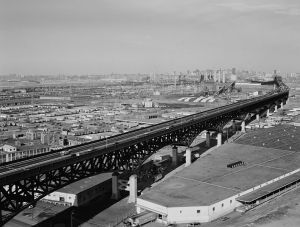
Caption: “FALLING APART – Replacing the Pulaski Skyway in North Jersey, which is in dangerous disrepair, would cost an estimated $1.2 billion.”   “A June study by the American Association of State Highway Transportation Officials ranked road conditions in New York, Connecticut and New Jersey 43rd, 44th and 50th, respectively, among the states.” … David Kocieniewski, NYTimes, July 24