Marine Transportation System

Archive for the ‘MTS Policy’ Category

We’re Just Getting Started

In Marine Highway, MTS Policy on October 8, 2010 at 10:04 am

[This first appeared in the America’s Marine Highway website and newsletter.]

Advocating for the AMH: We’re Just Getting Started

If we’ve learned anything about the developing American marine highway it is that it is developing incrementally and slowly.  A few nice-sized steps but no big leaps.

I have little doubt that the market will eventually demand greater use of the marine mode for domestic goods movement as the limits of landside capacity reach an economic tipping point and the imperative strengthens to use less fuel and produce fewer emissions. But the question to ask is whether it is wise to wait.  In 2007 Congress answered the question…sort of.

In a multi-faceted “energy independence and security” bill the energy efficiency of the marine mode was recognized. With the signing of Public Law 110-140 Washington said that it would be to the nation’s benefit to make greater use of coastwise and inland marine transportation. The U.S. Department of Transportation was handed a program outline and a few tools. It was told to return to Congress with recommendations as to any additional things that might be done to make it work. (No report as yet.) Then in 2009 Congress gave its approval to a grant program and appropriated a modest sum of $7 million.  [Note: since this writing grants were awarded.]

This year USDOT finally stepped up to implement that new policy and program. In August some projects were designated as eligible for grant funding and others were identified as “initiatives” to be encouraged.

The starting gun sounded on the American Marine Highway program…thus also signaling one of very few opportunities to improve the outlook for U.S. flag shipping.

There’s much to be done here in Washington. Federal funding is not the be-all and end-all of the marine highway program but it is crucial. Funding is how policy intent is measured in Washington. Is the $7 million the start of a serious effort or just flash-in-the-pan funding? Without an AMH budget for the Maritime Administration it will not have the program and staff resources to do much of anything in the next years. Without funding for AMH grants the Federal program will seem toothless. States and other transportation planners will ignore it. Start-ups may go only a short distance for lack of resources to secure that needed barge or crane.

Likewise, the policy provisions signed by President George W. Bush in 2007 are just a toe in the door. The next Congress should look more deeply into how marine highways can contribute to the overall transportation system and then decide what to do about it and the shipyard infrastructure needed to support it. I think there is plenty the legislature and this change-minded administration can do about it.

The next year or two will be a critical period that will decide if the new marine highway policy is to be taken seriously. Grant funding in FY 2011, commencing October 1, is unlikely, but it need not be a serious blow to the marine highway effort. For starters, we need to work to secure funding in the FY2012 budget and strengthen interest among policy makers.

Progress in the next years may continue to come in small increments along with an occasional large step. It is not easy to turn around business thinking about logistics or change attitudes in government about the role of domestic waterborne shipping but it can be done. Whether the marine highway effort in Washington falters or advances will depend on how strong and effective is the advocate crew…those of us who want to see more stars and stripes flying on the water.  Pbea
Raising the U.S.-Flag

In Marine Highway, MTS Policy, Surface Transportation Policy on September 7, 2010 at 11:13 pm

The lead on the June 21st American Shipper story caught the eye.  The chair of the House Subcommittee on Coast Guard and Maritime Transportation “says government programs aimed at helping the U.S.-flag fleet ply foreign trades have been a failure.”

“We have frankly struggled to find the policy that would truly improve and strengthen the U.S. marine transportation system…that would ensure we continue to have a robust merchant marine,” said Chairman Elijah Cummings (D-MD) in a private session with the Federal Maritime Commission.

On July 20th Chairman Cummings held a hearing on the subject.   He repeated his concerns about the state of the American industry in international trade and told MARAD Administrator David Matsuda that something should be done.

Some of the witnesses focused their testimony on the existing U.S.-flag programs—the Maritime Security Program (MSP) and the cargo preference program.

Administrator Matsuda cited numbers that summarize the industry’s decline.  He noted that the once substantial U.S. merchant fleet “created many of the technological innovations now used by the rest of the world” then stated this depressing fact:  “However, U.S. maritime programs have not been successful in inducing or even maintaining capacity within the Nation’s domestic merchant marine. “

Chairman Cummings told Matsuda, “We…should work to formulate a meaningful U.S. maritime policy that will revitalize our merchant marine and expand the percent of U.S. trade carried in U.S. ships.”  He wanted the MARAD to return with some ideas.

Given how long it is taking USDOT to unveil long overdue surface transportation recommendations–in part due to the White House aversion to talking revenue measures–one might imagine the subcommittee chairman waiting a little while for a new administration maritime initiative.

Here’s an idea.  Suggest to Congress that the place to start revitalizing the U.S. merchant marine is here in U.S. waters.  Rather than try to formulate a new policy by which U.S.-flag shipping can be competitive in the Asian trade, we should develop an ambitious initiative for the nascent and inadequately resourced American Marine Highway program here at home.

It is good to hear Chairman Cummings raise his concerns.  Whatever can be done to invigorate the U.S.-flag sector is worth considering.  It certainly is long overdue.

I will borrow words used by former Secretary Norman Mineta in a December 2007 speech about the broader U.S. maritime sector.  “Compared to the resources and focus that we have devoted to surface transportation and aviation,” Mineta said after having left the cabinet office, “I believe we must quickly and dramatically increase our attention, our funding, and our national purpose with respect to maritime issues.”

If there is an obvious opportunity to revitalize the maritime sector–one of this country’s earliest industries–it is in the short sea market, primarily the Jones Act trade, as part of a smart energy/environment/transportation policy framework.  If there is a way to give new life to the merchant fleet and bring U.S. shipyards to produce vessels for a new, greener generation it is through an expanded domestic market and a policy that takes the maritime sector half as seriously as Washington has taken other sectors of the economy.  Many of us would settle for half.   Pbea

Toward Developing MTS Related Policy

In Federal Government, Leadership, MTS Policy, Surface Transportation Policy on February 15, 2010 at 1:07 pm

Sitting the USDOT leadership in front of an audience has become a bit of a tradition each January.   Most of the brass, sans Secretary LaHood, appeared en panel at the recent TRB annual convention.  The policy and modal chiefs offered brief overviews as to what is on their plates.  Here are notes from two that have particular relevance to MTS related policy.

Under Secretary for Policy Roy Kienitz covered the big item — the next surface transportation authorization bill.   This year the Secretary’s office will pull together recommendations for the Obama White House to consider in preparing a package for Congress.

Roy stated the vision:  A renewed sense of strong federal leadership in transportation centered on meeting national needs.

He defined national needs: safety, state of good repair, economic competitiveness, livability, and environ sustainability.

The department’s priorities: organizing programs around those needs and recommending ideas to congress.

The challenges he described:  getting Americans excited about the vision and finding a politically acceptable way to pay for it.

David Matsuda, the Maritime Administration’s acting Administrator, is awaiting Senate confirmation.  He offered his take on what is what is driving the need to develop a vision for the marine transportation system as it applies to nation’s economic competitiveness.

The Panama Canal widening has the potential to significantly alter land and water routes.  Add to that potential changes relating to the use of the Suez, an Artic route, etc.    In short, we’re facing a whole new freight delivery market.

The Federal government must play an active role such as help “coordinate” investments in port access and intermodal connectors.  Few studies and data are available.  MARAD is commissioning a study to fully explore the impacts of a widened canal on our transportation system.

David said the study outcome is expected to shape national policies and help assess the capacity of channels, connections, etc.  He spoke of the need to factor in the capacity of port terminals and landside connections, the ingenuity of port authorities and terminal operators, and the competitive measures Canada and Mexico ports will take.  To understand how fuel prices affect freight economics.   And to identify marine highways to relieve surface congestion and move goods in a more energy efficient manner on the water.

There’s work to be done at the Department of Transportation.  And plenty reason for the freight community to plug into it.   Pbea

Ports on the Secretary’s To-Do List

In Federal Government, MTS Policy on November 8, 2009 at 11:49 pm

The DOT Secretary’s blog–Fast Lane–noted this past Thursday that “port managers have a difficult dual mission to fulfill-–providing the critical interface between water and surface transportation, while handling both commercial and military cargo.”  The prior day he met with the National Port Readiness Network, including some port representatives.

Secretary Ray LaHood acknowledged in his blog that that dual mission “is much easier said than done. ”  “And I get that only the commercial side of their mission provides the ports compensation.”  He said “DOT wants to do all we can to help them meet these obligations.”

Back in March when Secretary LaHood addressed the spring meeting of the American Association of Port Authorities he was asked from the floor what the new administration was thinking in the way of a freight policy.  The cabinet member said his department had yet to give it attention, that implementation of the stimulus package was USDOT’s  immediate focus, and toward the end of the year he may convene stakeholders to start to develop a perspective on freight.

It sounds like he is ready to act on that idea.  In recent weeks he indicated to Kurt Nagle of the AAPA that USDOT will call port directors together for purposes that include an examination of freight issues.  The plan is to have a meeting–perhaps in New Orleans–this coming January.

He noted in this blog of November 5th two action items–a “port summit” and “a Presidential initiative to integrate planning” with DHS.

The former appears to be focused on the port authorities–the public agencies with port jurisdiction.  A government to government conversation makes sense.   But will the Secretary at some point also enlist the private sector side of the ports–the terminal and vessel operators–in a confab to examine freight issues?  And will this be the start of a concerted effort in the Secretary’s office to develop an overdue Federal freight policy?

The latter is a reference to a $15M item in the current year budget–also in the Senate version of the DOT appropriations bill.  “This will help develop and modernize the freight infrastructure that links coastal and inland ports to highway and rail networks,” LaHood said in the blog.  We’ll have to wait and see how that  intention will materialize in actual projects.  Earlier this year MARAD folks said that some or all of it may be applied to marine highway initiatives.

We’ll see how these two items on the Secretary’s to-do list develop.  In the mean time it’s good to know that Secretary LaHood wants to listen to the ports and focus some resources on the MTS.   Pbea

Say It Again, Solon

In Marine Highway, MTS Policy, Surface Transportation Policy on October 5, 2009 at 5:33 pm

Some things are worth repeating. Especially on the subject of putting our waterways and waterfront to greater productive use.

Here’s a for-instance — excerpts from a recent statement by Rep. John Mica (R-FL), the ranking minority member of the House Transportation & Infrastructure Committee, as submitted to the America’s Marine Highways website.

  • “As construction costs rise, and as the resources to address our growing infrastructure needs become stretched thinner by the day, it is…important that we use all of our transportation assets more wisely and effectively.
  • “I have advocated for the development of a national strategic transportation plan that considers our various modes of transportation as components of one comprehensive system, drawing on the strengths of each mode, rather than as separate unrelated transportation systems.
  • “The nation would clearly benefit from the greater use of coastwise trade on our nation’s marine highways as part of a national transportation strategy” …. “Marine highways are energy efficient and can yield positive environmental benefits.
  • “If waterborne routes are to be fully used, industry must develop new options that are better suited for moving higher value and more time-sensitive goods.
  • “However, there are still roadblocks that may limit the establishment of new waterborne transportation routes. Chief among these is the imposition of the Harbor Maintenance Tax on cargo carried by vessel between U.S. ports.
  • “Of course, all proposals to better use our transportation system faces challenges…. Financing ships without the commitment of cargo is not easy. Obtaining a commitment for cargo without existing ships and an established schedule is not easy. Financing and permitting for the expansion of port facilities is never a simple or easy task….  However, these are challenges we can and must overcome.”

John Mica is an influential Member of Congress who is playing a key role in the crafting of the replacement for SAFETEA-LU, along with his counterpart Chairman Jim Oberstar, another supporter of the marine highway.   Mica is one of a small number of legislators who has spoken in terms of national strategic transportation planning, modal components being of a single transportation system, and the importance of developing the marine highway…all in the context of surface transportation policy.

That’s worth repeating…and reading in full.  With any luck his colleagues of the House and Senate will listen.   Pbea

Rail Shows the Way to the Water

In MTS Policy on September 3, 2009 at 8:27 am
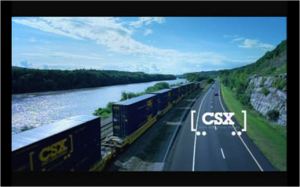
RiverRailRoad

Closing image from a CSX commercial

This is a compelling image but not necessarily in the way intended by the folks at CSX.

For good reason I’ve heard many people credit CSX for the quality of its television commercials.  Norfolk Southern and the collective Class I industry also have put up very effective ads that have been running for a few years.   The message is exceedingly simple.  On a ton-for-ton basis rail is a fuel efficient and low carbon-footprint way to move lots of freight now traveling on the highways.

The ads are shown repeatedly in this D.C. market because this is where policy makers and influencers are.   The railroads want Congress to approve a targeted 25%  tax credit for their infrastructure investments.  They also know that new climate and energy policies could affect their bottom line.   So the industry is investing  millions to instill a favorable public image.  It is working.  Green groups are lobbying for more freight trains and fewer trucks.

As an admirer of the ad campaign I use this image in presentations about the need for marine highway policy.  The ad accomplishes two things for those of us who think that the even greater efficiency of marine transportation deserves equal attention.

First, it graphically reveals the availability of waterside capacity for the surface transportation system.  It is hidden capacity, metaphorically speaking, when early in the commercial the focus is on containers lifted from the congested roadway to the nearby train.  Then our last view is of a waterway so uncongested as to be empty of vessels.

Second, it serves as a challenge to the maritime industry, which  can top the railroad claims about fuel efficiency.   The tug and tow companies have undertaken a modest general ad campaign to carry that message.  However that AWO effort is the only one.  The present and future marine highway–including the capacity of ships to carry trucks themselves–remains a hidden asset because the larger industry isn’t telling the story.

There is no comparing the resources of the rail and barge industries.  So don’t look anytime soon for a comparable televised promotional effort by vessel operators.  Nor have I seen signs that the broader maritime sector is ready to pool resources to promote the marine highway to Washington.

If the public and the policy makers are to learn about the advantages of marine transportation and the potential for addressing some of the nation’s growing transportation challenges it will happen when the maritime sector comes together to carry that message.   The railroads can’t be counted on to place more subliminal maritime messages on TV.  Pbea