Marine Transportation System

Archive for the ‘Ports’ Category

HMTF: The Seven Billion Dollar Clue

In MTS Policy, Ports, Water Resources on February 11, 2012 at 6:04 pm

The Harbor Maintenance Trust Fund (HMTF) is overdue for a remedy. How do we know? The unspent balance of Harbor Maintenance Tax (HMT) receipts, plus interest, is a mere $7,000,000,000.

HMT receipts are accounted for in the channel “maintenance” trust fund. However (not to be too picky) the Federal channel system is not fully maintained, and not for lack of money (see “mere” above). That and other information can be found in this 2011 report by the Congressional Research Service.

(A Moment for Trivia: The HMT is considered by some folks a user fee but as the Supreme Court figured out, unanimously and with little effort, the value-based charge on cargo bears little relationship to the service being provided i.e., maintaining channel depths and other dimensions for vessels, and “therefore does not qualify as a permissible user fee” under the export clause of the Constitution.)

The HMT is collected on import and domestic cargo handled at most US ports. On cruise tickets, too. The majority of what is collected comes from the high volume, high value imports; much less from comparatively low value domestic cargo moving between American ports. US exports cannot be charged, sez the Supreme Court.

The HMT was set to cover 100 percent of the cost of coastal channel maintenance. But if 100 percent of the channel maintenance that is needed isn’t done then 100 percent of the funds isn’t spent. It’s the kind of math that even I can understand.

Well, you might say, that’s okay because the money is safe in a trust fund. It is dedicated for maintenance dredging, right? It will be there when it’s needed, right?

Sure, but the balance has grown every year since 1994 and, more to the point, full funding is justified now. According to the Corps of Engineers the total channel system, including small recreational harbors, would cost around $1.3 billion a year. And even if the money is sitting in a trust fund collecting interest, it actually is being put to an unrelated purpose. Turns out the HMTF is a handy offset, especially when you are running a Federal deficit. Makes the deficit a little lower–$7,000,000,000 lower.

The money is collected for a specific purpose but is not being spent fully for that purpose. More than a few folks argue that is not fair. Especially the ones who have a direct stake in channel dredging such as ports and dredging contractors.

But then fairness has been an issue since the HMT and the HMTF were made law.

In the mid-80s Congress deliberated how to offset the cost of Federal channel maintenance (originally by 40 percent and then a few years later by 100 percent). Some ports argued that because heavy cargo weighs down a ship the new user fee for maintaining channel depth should applied to cargo tonnage.

Other ports took the opposite view, pointing to how heavier cargoes are often low value as well as low margin US exports. They said the charge should be on cargo value, arguing that containerized cargo could afford the charge. And since the vessel operators had already succeeded in fending off a fee on the vessel (arguably the direct user of the channel) it came down to which ports and kinds of cargo had the most, or least, votes in Congress.

The “fairness” question was decided in favor of the greater number of ports, which were export oriented and/or whose channel maintenance costs might be expected to exceed channel fee collections in those harbors.

As was patently obvious the major international gateways would produce a substantial portion of the revenue. Indeed in 2005—yes, most HMTF data is musty stuff because the Federal government unreliably produces the mandated annual report—the top cargo value ports of LA (13.7%), NYNJ (12.2%) and Long Beach (12.2%) represented nearly $380 million, which was more than one-third of HMT receipts. The top ten ports by value handled over 68 percent.

Some of them, as it happens, also require little in the way of channel maintenance. (I’ll get more into that subject in a later post.)

The HMT and the HMTF are in ways unfair and they are imperfect by design. The value basis of the tax can be explained as a seaport maintenance policy crafted for nation where no seaport has the same cargo, cargo type, volumes or geography and whose Constitution forbids Congress giving “preference” to one port over another (Article 1, Section 9).

We can’t be so generous and understanding with the way the HMTF is crafted in law and managed in the budget process.

Changing the basis of the HMT is politically unlikely (see “snowball’s chance in Honolulu”). As for the HMTF, changing the law is not easy but it is doable. (To be continued.) Pbea
The Mineta Speech, Pt.3

In Federal Government, Infrastructure, Leadership, MTS Policy, Ports, Water Resources on February 8, 2011 at 3:07 pm

Former Transportation Secretary Norman Mineta offered his audience at the North American Port and Intermodal Finance and Investment Summit recommendations “we can act on immediately” to address the inadequate “role of maritime issues in our national transportation policy.”    Here are Pt. 1 and Pt.2. Pt.3 follows…

It struck some people as a bit odd.  Here Norman Mineta was talking about changes that are needed to strengthen U.S. maritime policy but he waited until he was out of office  to raise them.  Perhaps these were ideas that coalesced in his mind only once relieved of the day-to-day tasks of office.  Maybe not.   Ultimately it didn’t matter.  At least he was raising them now.

“What is the path to victory?  I have ten recommendations we can act on immediately.  Some are major and some seem to be minor, but are critical to success.

“First, the Federal government must reorganize the Maritime Administration – MARAD.  I would rename it for what it should become – the Federal Maritime Administration, and I would combine virtually all of the Federal maritime responsibilities there.  It should reinvigorate the uniformed Federal Maritime Service and transfer the aids to navigation responsibilities from the Coast Guard to it.

“The portion of the Army Corps of Engineers whose responsibilities and capabilities for our domestic ports and waterways should be relocated to the Federal Maritime Administration.  The Army performing as domestic civil Federal engineers is not a role for the military and the country would save money and get a better product if these services were transferred to a single maritime agency.

“Secondly, the new agency must shift its focus to the condition of the nation’s ports and waterways and the role of this infrastructure in the totality of the U.S. transportation system.  The current agency has too many of its resources and its structure focused on the issue of ships and crews.

“Thirdly, the Merchant Marine Academy in Long Island should be renamed the National Maritime Academy.  It should be a Federal service academy where every graduate must perform his or her service in the Federal Maritime Service or as a commissioned officer in one of the other services as they do now including the Department of Homeland Security.  This Academy is one of the major assets of the Federal government and we need to give it our time and attention.

“Fourthly, the Federal government must develop a legislative reauthorization process that puts maritime issues on the same priority and level of importance that surface and aviation assets currently have.  If ports and waterways funding is always being relegated to parts of the surface transportation bill, or the defense bill, they will remain second-class subjects where the hope is to get your particular project an earmarked status.

“Fifth, the U.S. must revitalize its role in international maritime organizations and its maritime relations with other countries.  Whether its treaties or issues involving security and trade, the U.S. needs to give more time and attention to these areas.

“Earlier I said to achieve this refocus on maritime importance, state and local governments, port authorities, and other government entities reliant upon maritime trade must work with industry stakeholders to educate American citizens and their decision makers regarding U.S. reliance on a strong national maritime system.

“Therefore, I believe the next set of actions should begin with port and waterway interests and industry stakeholders – including financial players who want to enter this sector – creating a national association whose charter is to accomplish the following action items:

“Educate the Congress and the presidential candidates on the role of the national maritime system and get hard commitments to take action.  Educate American decision makers and others on the role maritime assets play in how freight and goods are delivered to them.  Then enroll them in the effort to get maritime’s fair share of infrastructure resources.

“My final recommended action is that you accomplish all of the above by overcoming the inevitable opposition – not only from without but from within.  Within the maritime industry there are many agreements of mutual mediocrity.  People are familiar with this system and will not want to see it changed.  The ground is shifting under their feet and they imperil needed financial investment and the innovation and the efficiencies it brings.

“Also, there are issues that need to be addressed within the industry – labor agreements, the role that technology will play in the labor force, and how security issues will be addressed.  These are important issues that need to be vigorously debated and resolved – but they are not reasons to oppose raising the importance of maritime issues on the national agenda.  Take a side in these issues, fight for them, but do not let it dominate the larger objective.

“Finally, for those of you who are looking for quick investments in ports and maritime infrastructure, I’m not sure I’ve given you a lot of useful information.  And for you I’m afraid there is more bad news.  There are no quick rates of return to be made here.  Private investment into ports and infrastructure will have to be a true and long-term partnership.

“The up side as we say is that this is an industry that has the potential for tremendous growth and to have a real impact on our national transportation system.”

So there you have it.  A message that is important not so much for the specific recommendations made–although there are some good ones there–but for the fact that he was putting the spotlight on a problem that few public officials and industry people bother to talk about or even acknowledge.  See the next post for some additional  thoughts.   Pbea

Green Move at FMC

In Environment, Green Transportation, Ports on January 8, 2010 at 2:49 pm

The Federal Maritime Commission has formed a Maritime Environmental Advisory Committee.  This isn’t fresh news–the FMC announced the action last November–but it’s still worth noting.

It is a smart move by Chairman Rick Lidinsky.  He announced it, appropriately so, while on a visit to the San Pedro Bay ports.  Says the FMC press release: “I wanted to recognize these ports’ leadership in demonstrating that the maritime industry can remain commercially competitive while acting in a manner consistent with the country’s commitment to energy independence and environmental standards.”  While those two largest of US ports have led the way in greening seaport operations the Lidinsky comments were a particular reference to the ports’ more recent Clean Trucks Program. It was his way to demonstrate the agency’s new leadership.

The program–in conjunction with the efforts of an enlightened shipper community–has been very successful in reducing port drayage trucking diesel emissions by a praiseworthy 80 percent.  Doing it well ahead of schedule.  The program has inspired similar action in other parts of the country and, with the exception of one particular element, has the strong support of both public and private interests.  (The exception is the controversial “employee driver” provision in the Los Angeles plan that is being challenged by the American Trucking Association in court.)

The formation of the FMC panel followed by several months a decision in the FMC to halt its action against the ports of Los Angeles and Long Beach.  Their joint action raised technical issues under the Shipping Act and that prompted an FMC complaint in court as well as the decision to start an FMC enforcement investigation.   (The environmental objectives of the  clean trucks program were not challenged.)   The decision to withdraw the complaint took place before Lidinsky’s arrival at the FMC.

The bid in court  proved unproductive.  I’ve not the training to judge the merits of the  complaint.   But I do know that the new chairman–a sharp fellow–knew what he was doing when he asked his staff what was their understanding of the environmental issues that color and confront maritime related activity in the United States today.

On learning the answer Lidinsky took action.  A Maritime Environmental Advisory Committee was formed.  Strictly an internal panel, the press release notes that the staff committee’s purpose is “consistent” with Obama administration policy for the development of “green jobs”, etc.  A reference to creating jobs is de rigueur for a government  press release these days, likewise an ethos statement on seeking “a more sustainable approach to maritime issues.”

On a more basic level, however, the new advisory committee would help the commissioners understand what is going on in the maritime realm and tune the agency’s work–its deliberations and services–to what is an undeniably changed environment–regardless of the party in power–in which business and government now has to operate.  And smartly so.   Pbea

Obama Jobs Initiative: Meaning in Missing Words?

In Infrastructure, Ports on December 8, 2009 at 4:19 pm

This is what is in the president’s jobs proposal announced today with respect to infrastructure investment:

2. Investing in America’s Roads, Bridges and Infrastructure

Additional investment in highways, transit, rail, aviation and water. The President is calling for new investments in a wide range of infrastructure, designed to get out the door as quickly as possible while continuing a sustained effort at creating jobs and improving America’s productivity.

Support for merit-based infrastructure investment that leverages federal dollars. The Administration supports financing infrastructure investments in new ways, allowing projects to be selected on merit and leveraging money with a combination of grants and loans as was done through the Recovery Act’s TIGER program.

The second paragraph is a reference to the over-subscribed TIGER grant program for which a broad range of transportation projects are eligible and awardees will be announced no later than February.  The administration has shown an affinity for “merit-based” grants (as opposed to congressional earmarks and formula funding).   USDOT loves it because it puts the Secretary in the position to judge what projects are worth funding and to apply White House principles such as emission reduction.

With so little in the way of detail we might infer from the first paragraph that the Marine Transportation System may not be as much as part of the next jobs bill as it was in ARRA signed in February.  Does the Obama administration include port or marine transportation as eligible for job stimulus funding?  Especially for  the “out the door” quickly category?

Certainly connecting roads and rail are valuable elements of the MTS but when the president’s proposal for infrastructure funding uses the term “water” it may not mean maritime.  I think it means water and sewer infrastructure, which would appeal greatly to capital starved municipal governments but do little for marine highway and other MTS infrastructure needs.

Prior references by Congress and the administration to funding maritime related projects as part of ARRA used the word “port“ along with rail, highway and transit projects.  No mention of port or maritime in the White House statement or the president’s remarks at the Brookings Institution today.

That said, port/maritime projects were eligible for TIGER grants, which the White House appears to want to continue.  But almost by definition TIGER grant money doesn’t flow in a matter of couple months.  The first grant announcements won’t be made until close to a year after the funds were appropriated by Congress in February 2009.  Indeed, I’m told that White House officials said after the president’s remarks that some part of the infrastructure element of the s announcement today may not be intended to pour money into the system over the short term.

The White released an outline today.   The administration and Congress will put flesh on the bones and maybe once the House and Senate take up legislation early next year ports and  marine transportation, including capital needs for marine highway development, will be eligible.

For that to happen, the industry will have to make its case.     Pbea

California Trailblazing to a Miami Tunnel

In Intermodal, Ports, Surface Transportation Policy on November 17, 2009 at 11:04 pm

When earth was turned in 1997 for the Alameda Corridor project in the San Pedro Bay port region more than one kind of ground breaking was occurring.  The Port of Miami is a beneficiary.

In freight transportation policy circles the Alameda Corridor project one day may be legend.  The ports of Los Angeles and Long Beach were the gaping end of a freight funnel that emptied import boxes onto the exit rails and streets.  In essence the solution was to eliminate grade crossings by building a blow-grade rail way out of town.  A big project with a $2.4B price tag.  A key to the financing was Federal credit assistance.  The project and two others in California were the first to benefit by this innovation.  A paper on the FHWA website tells the story.

Due to Federal budgetary constraints, however, the grant was not deemed to be a fiscally or politically viable option. An alternative form of Federal support for this project was needed, and by 1997 the answer was clear: Federal credit enhancement in the form of a junior-lien loan to ACTA.

The fiscal year 1997 Omnibus Consolidated Appropriations Act (Public Law 104-208) provided $58.7 million for DOT to cover the capital reserve charges associated with making a direct loan of up to $400 million to ACTA for the Alameda Corridor Project. This represents an actual budgetary cost of 14.7 percent of the face value of credit assistance. The legislation also provided that the loan be repaid within 30 years from the date of project completion and that the interest rate on the loan not exceed the 30-year Treasury rate.

Inspired by the success of leveraging non-Federal investment for large infrastructure project, particularly private financing, Congress in 1998 fashioned a fully articulated TIFIA program.  It was adjusted in SAFETEA-LU with a lowered threshold to make more projects eligible.

Nearly $7 billion in projects in 13 states have benefited since TIFIA was created by Congress.  The Port of Miami’s rail freight tunnel had an uncertain future but with the October announcement the financing is in place and a $607 million construction project soon will be underway.  Not bad.   Pbea

.

A Slice of Pie for Hungry Ports

In Infrastructure, Ports on October 13, 2009 at 11:25 pm

I’m not sure if this is a troubling sign but Sally Fields comes to mind when I think of TIGER grants.

Those are the multi-modal, discretionary grants that were created in the economic stimulus bill Congress approved last February.  The pleased folks at USDOT dubbed the program TIGER–a suitable acronym–and put flesh on the bones. Pleased because this was one of those rare times when Congress was willing to say: “Here, Mr. Secretary, is 1,500,000,000 dollars for you to spend, outside of existing modal grant programs, at your discretion.

There were some rules of course, but none of the earmarked projects Congress is so fond of TIGERpiedesignating to the fullest extent of available funds.

And with a reform-oriented SAFETEA-LU sequel due to be written by Congress it was not lost on USDOT that if the TIGER program were managed well–whatever “well” might mean to congressional overseers–it could be a model for replication.  USDOT may be entrusted to award more competitive grants on the basis of project merit and worth to the country.  Imagine that.  (Indeed, the Senate DOT appropriations bill for FY 2010 includes $1.1 Bn for additional TIGER grants.)

In the months that followed enactment of the $750 Bn stimulus package–some $48 Bn of which was allocated to USDOT for near term implementation–Secretary Ray LaHood told port officials and others involved in the MTS that port project applications would be welcomed for TIGER grants.  He told the D.C. Propeller Club audience in May that the maritime sector has been neglected and TIGER grants were an opportunity.

Well, the ports listened.  Shades of Sally Fields!  When in 1985 she won her second golden statue for her role in Places in the Heart the former “Flying Nun” famously cried, “You really like me!”

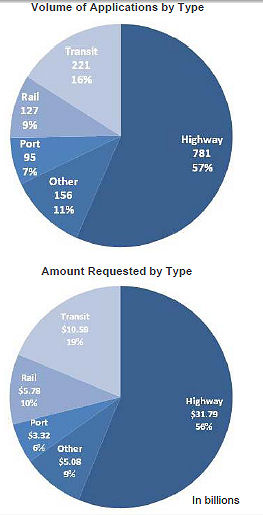
The ports took to heart the Secretary’s encouragement. He really wanted them to apply for grants and apply they did.  Ninety-five applications were submitted for port related projects totaling $3.3 Bn.  Certainly the smallest of the modal slices on the pie chart, but not an overwhelming difference when compared to rail.

Toward what end?  We’ll learn in February what projects are approved and how many are for ports.  The TIGER grants and pending legislation to grant MARAD infrastructure improvement authorities are signs that change may be in the wind.  The Feds are becoming more open to assisting ports with more than just channel construction and maintenance.  Certainly MARAD is eager to claim new program areas.  And some of the ports, perhaps an increasing number, are welcoming the help of Uncle Sam…maybe even inside the gate.   Pbea

Will Ports Be Ready? (Part 3)

In Efficiency, Ports on September 17, 2009 at 11:22 pm

Will U.S. ports, especially those on the Atlantic and Gulf coasts, be ready to operate in the changing domestic and international commercial environment? With major shifts on the way the ports that adequately prepare will be the ones to maintain and gain market share.  A shift in buying power—where the consumers are—may be the greatest change facing major gateway ports throughout the U.S.

Consumer Demand
The primary end-consumer of manufactured goods is shifting east—Far East.  For U.S. ports, it is going to be as important to be an efficient “export port” in the coming decade as it was to be an efficient “import port” last decade.

Over the last decade a significant shift in national and individual wealth occurred from America and Europe to the Far East and India.  In the next several decades the emerging middle classes in China and India will be the primary global goods and services consumers.  China already has a middle-class of 300 million, approximately the same number as the U.S. total population.

An increasing demand for goods will be driven by two phenomena: population growth and economic convergence.  The world population (currently at 6.8 billion) is expected to reach 7 billion in late 2010 and to reach 8 billion within 20 years, or sooner.  (Much of this growth will be in Asia and Africa, but by 2050 it is projected that India will be the world’s most populous nation.)

Approximately 80 percent of these new individuals will have discretionary incomes nearly equal to their western counterparts because of increasingly convergent economic patterns for most nations.  Meanwhile western-populations will age and increase their savings rates in order to provide for their retirement years.  In short, the demand will be on the other side of the planet.

The Bottom Line
U.S ports planning to participate in the international trade and transportation business will have to be agile, 2-directional (serving both imports and exports), environmentally sound operations, and take advantage of economies of scope and scale to compete in the 21st Century.  These are business considerations that should be included in a port’s strategic business plan to maintain and gain market share.

T. H. Wakeman

Will Ports Be Ready? (Part 2)

In Environment, Ports on September 15, 2009 at 5:14 pm

Will U.S. ports, especially those on the Atlantic and Gulf coasts, be ready to operate in the changing domestic and international commercial environment? With major shifts on the way the ports that adequately prepare will be the ones to maintain and gain market share.  The change in environment—at local, national and global levels—will be a constant factor not easily addressed.

Environmental Concerns
From 2002 to 2007 many ports found it necessary to have a proactive environmental policy to get community approval to operate and expand.  Most major ports experienced double digit volume increases that resulted in problems with surrounding communities over increasing road congestion, noxious air emissions, and safety concerns.  In the San Pedro Bay ports communities voiced their anger to local politicians and in short order port projects were put on hold.

With the collapse of global trade, the pressure subsided as the number of containers and trucks decreased.  However, all indications suggest that world trade will rebound and cargo volumes will double by 2040.  Community concerns and political problems will re-emerge as well.  Other environmental issues may also emerge to affect port business practices—consumption of non-renewable resources, bio-hazards, and concerns about species redistribution that may persist even with ballast water regulation.  A proactive policy may again be a necessity for certain major ports if their environmental performance is seen as problematic for their neighbors.

Green house gases (GHG) are probably going to be the biggest environmental game changer for businesses as climate change policy is put in place and businesses calculate the added expense.  The U.S. contributes 20 percent of the world’s emissions from burning fossil fuels; India contributes 4 percent.  Will there be a carbon tax or cap and trade policy established worldwide?  What will be the cost penalty for oceanborne cargo here or worldwide?  How fast will engine room and terminal equipment technology adapt?  Those questions await answers and clarification.

As climate change concerns and political acceptance addressing those concerns increase, the pressures to aggressively address GHG will be enormous.  (That is likely notwithstanding the relative environmental and energy per-ton/mile efficiency of the marine and rail elements of MTS related transportation.)  These issues will have even greater impacts on the cost of ports, particularly if dealt with retroactively.

Next: Consumer demand and the bottom line.

T. H. Wakeman

Will Ports Be Ready? (Part 1)

In Infrastructure, Ports on September 13, 2009 at 10:15 pm

Will U.S. ports, especially those on the Atlantic and the Gulf coasts, be ready to operate in the changing domestic and international commercial environment? With major shifts on the way the ports that adequately prepare will be the ones to maintain and gain market share. Cargo flow volumes will shift in a big way.  This is the first of a three-part observation by our new contributor Thomas H. Wakeman III, Eng.Sc.D.

Panama Canal
The one approaching shift that escapes no port’s attention is the Panama Canal.  The Panama Canal Authority is investing $5.3 billion to widen and expand the canal’s capacity to service the current generation of 8000+ TEU container ships.  When the new locks open in 2014, a new era will begin.  It could change global trading patterns just as the initial canal opening did in 1914.

As much as 25 percent of today’s West Coast cargo base could be transferred to East and Gulf Coast ports as global trade picks up again.  There will only be one chance to gain control of the initial surge.  It will be the deepest East and Gulf Coast ports with corresponding intermodal connections and warehousing capacity that will capture this shift in market share.

Economies of Scale/Scope
Achieving economies of scale and scope will determine the mega-players.  It started with increasing ship size first among the bulk carriers and then emerged with the container carriers in the latter part of last century to secure economies of scale.  Because margins are razor thin only ports and their supporting infrastructure systems (whether as import or export corridors) with sufficient capacity and efficiency effectively will compete and perform in the global marketplace among the major “port poles”, forming as collaborative networks in Asia, India, and Europe to achieve economies of scope.

These port poles, which combine the infrastructure and business services of more than one port into a mega-region logistics platform, have the ability to be agile, cost-effective and resilient when shocks occur.  They are seen as reliable routes by shippers – giving them agile and flexible networks.

Infrastructure
Time and reliability are the watch words for global business.  As goods flow across the world’s oceans, through our ports, and connect to domestic corridors, they face time delays in route and uncertainty about ultimate delivery schedules because of infrastructure capacity constraints.  Freight must flow seamlessly or there is a time, cost and reliability penalty.

India plans to increase infrastructure spending to 9% of GDP (an estimated $500 billion) by 2014, up from the current 4%, on roads, ports and airports.  In China, according to the Asian Development Bank, the figure is close to 10% GDP for 2008-2009.

The US has been living on its past construction accomplishments.  According to the Congressional Budget Office, between 1984 and 2004, the U.S. capital investments (including federal, state, and local) averaged less than 1.2% GDP.  Our growth of demand and lack of investment was unsustainable.  Without the recession, we would have been overwhelmed by traffic, much less prepared for what is going to be demanded in the next decade.   Our infrastructure systems can not deliver what business is going to require for maintaining global competitiveness without significant investments.

Next: Environmental Concerns

T. H. Wakeman

LaHood: Marine Highway as Transformational

In Ports on July 27, 2009 at 2:24 pm

DOT Secretary Ray LaHood was in Oakland on July 2nd talking freight and ports.  He was importuned by local, State and Federal office holders about the need for a national goods movement policy.  He was told that infrastructure improvements strengthen the capacity of ports to serve the nation.  He  heard them say there’s a need for equity among West Coast ports.   He volunteered that a California “ports czar” might be what’s needed.  (Although that may not be what the folks in Oakland have in mind.)

He also reiterated his view that marine highway development should be realized and would be “transformational.”  His tweet from Oakland: “US ports provide transportation for the 21st century.”

The key to creating more environmentally friendly ports, LaHood said, is to transport more goods by ship rather than trucks. He mentioned, in particular, the importance of a “marine highway” along the West Coast. “We will be putting a good deal of emphasis on the marine highway in order for us to get trucks off the road and get cleaner air,” LaHood said. (Source: Chris Metinko, Oakland Tribune)