Marine Transportation System

Posts Tagged ‘freight’

A Million Reasons

In Leadership, Surface Transportation Policy on September 21, 2009 at 12:26 pm

TollBanana

“Funding is the key,” said former DOT Secretary Norman Mineta.  He should know.

Mineta spoke to an estimable eighty invited to UVA’s Miller Center of Public Affairs to discuss how significant reform in surface transportation policy might be achieved.  He told them that funding is the prerequisite for the kind of major investment measure that all agreed is needed.

Noting the particular challenge, Mineta recalled how he  brought to the Bush (43) White House a proposal to add two cents to the Federal fuel tax.  The intent was to elevate road and transit program funding to level closer to actual system need.  The Commander-in-Chief said no.

Pop Quiz:

  1. On what bill did George W. Bush first exercise his power of the veto?  (Softball.)
  2. Aside from a $8 Bn game-changing plan to jump-start high-speed passenger rail, which president ruled out any immediate action on a major transportation infrastructure program because he (that’s a hint) was not inclined toward a tax hike or other revenue measure? (But why just pick on presidents?)
  3. Is there a snowball’s chance in Haiti that Congress will pass the next full-fledged TEA bill anytime soon?

(Answers: SAFETEA-LU, Obama, Not likely.)

It’s not a stretch to suggest that it may take years for official Washington to approve a costly multi-year surface transportation bill.  Certainly one that includes substantial reform  (such as sustainable transportation and livable communities), new attention to freight gateways and corridors, and overall higher levels of capital investment in our declining public works.  Hundreds of billions are needed over and above what is required to maintain what we already have.  And a declining highway trust fund makes even maintaining the status quo a pressing challenge.

Josh Vorhees of Energy & Environment News wrote a good story carried by the NYT.  The conferees at UVA know the timidity of the Electeds when it comes to approving new revenue increments to support this or that.  When it comes to the partisan battlefield there is no distinguishing a user fee from a tax.

Some time ago, when a toll increase was being contemplated by staff of  a public authority, the subject was referred to as “The Banana. ”  The T-word was not uttered in internal discussions–lest others outside the agency get wind of it before the numbers were fully crunched and the rationale fully developed.  “The Banana” was a calculated, albeit humorous, way to manage in the hyper-sensitive political world.

A some point–much sooner than later–the million reasons why a tax payer or system user should not be charged must be faced by our Electeds.  At some point the fact will sink in that America’s competitiveness is declining as other nations  are  using this lousy global recession as reason to engage in major infrastructure improvements.

Mort Downey recounted last week at a freight-related event how over the years Washington has managed to extend or raise the vehicle fuel tax even when the economy was in distress.  Somehow we survived.   Pbea

Will Ports Be Ready? (Part 2)

In Environment, Ports on September 15, 2009 at 5:14 pm

Will U.S. ports, especially those on the Atlantic and Gulf coasts, be ready to operate in the changing domestic and international commercial environment? With major shifts on the way the ports that adequately prepare will be the ones to maintain and gain market share.  The change in environment—at local, national and global levels—will be a constant factor not easily addressed.

Environmental Concerns
From 2002 to 2007 many ports found it necessary to have a proactive environmental policy to get community approval to operate and expand.  Most major ports experienced double digit volume increases that resulted in problems with surrounding communities over increasing road congestion, noxious air emissions, and safety concerns.  In the San Pedro Bay ports communities voiced their anger to local politicians and in short order port projects were put on hold.

With the collapse of global trade, the pressure subsided as the number of containers and trucks decreased.  However, all indications suggest that world trade will rebound and cargo volumes will double by 2040.  Community concerns and political problems will re-emerge as well.  Other environmental issues may also emerge to affect port business practices—consumption of non-renewable resources, bio-hazards, and concerns about species redistribution that may persist even with ballast water regulation.  A proactive policy may again be a necessity for certain major ports if their environmental performance is seen as problematic for their neighbors.

Green house gases (GHG) are probably going to be the biggest environmental game changer for businesses as climate change policy is put in place and businesses calculate the added expense.  The U.S. contributes 20 percent of the world’s emissions from burning fossil fuels; India contributes 4 percent.  Will there be a carbon tax or cap and trade policy established worldwide?  What will be the cost penalty for oceanborne cargo here or worldwide?  How fast will engine room and terminal equipment technology adapt?  Those questions await answers and clarification.

As climate change concerns and political acceptance addressing those concerns increase, the pressures to aggressively address GHG will be enormous.  (That is likely notwithstanding the relative environmental and energy per-ton/mile efficiency of the marine and rail elements of MTS related transportation.)  These issues will have even greater impacts on the cost of ports, particularly if dealt with retroactively.

Next: Consumer demand and the bottom line.

T. H. Wakeman

A Decent Man and Industry Leader

In Leadership on September 14, 2009 at 1:03 pm
Bill DeCota  (source: www.bigapplegreeter.org)

Bill DeCota (source: http://www.bigapplegreeter.org)

Bill DeCota was not someone you would have met in the MTS world.  He didn’t know ships, but he appreciated that there could be a role for marine transportation at his facilities.  He didn’t know freight rail, but he knew that rail is an essential component in intermodal transportation.  He may have never set foot on a container terminal, but he understood the importance of efficient goods movement.

Bill DeCota knew airports and aviation.

On September 11th, as his colleagues at the Port Authority of New York & New Jersey were re-living the tragedy of eight years before, Bill passed away at age 51.

For nearly ten years Bill DeCota headed the agency’s Aviation Department.  LaGuardia, Newark, Kennedy, Teterboro, and now Stewart.  He joined the Port Authority in 1982 as a financial analyst and well before his untimely death he had earned the respect of his staff and industry leaders.

Like other highly competent persons Bill could have left public service for greater financial reward in the private sector.  Instead he close to work to improve the country’s busiest and highly complex passenger and freight airport system in the high-pressure, floodlit New York metro region.  The region and his employer were prime beneficiaries of his talent.  Anyone who didn’t fully appreciate that fact when he was alive surely will come understand it in his absence.

He had impressive intellectual capacity, lived his work 24/7, had great integrity, demanded no less of himself as he did  of his staff.  He was a national leader  in the industry.  He probably was without peer in his command of the  statistical and financial minutiae.  He was a man of good humor and enjoyed his own, frequent quips.  And as an added gift Bill was a genuinely good guy.  He was friend and colleague to people, myself included, regardless of rank.  Patty Clark of his staff said of Bill: “He had as much concern for the busboy at his dinner, as he did for his long term friends.  The caring and concern which were the hallmark of his life, he eschewed when directed at himself.”

It is the transportation world’s loss that he is gone.   Pbea


Will Ports Be Ready? (Part 1)

In Infrastructure, Ports on September 13, 2009 at 10:15 pm

Will U.S. ports, especially those on the Atlantic and the Gulf coasts, be ready to operate in the changing domestic and international commercial environment? With major shifts on the way the ports that adequately prepare will be the ones to maintain and gain market share. Cargo flow volumes will shift in a big way.  This is the first of a three-part observation by our new contributor Thomas H. Wakeman III, Eng.Sc.D.

Panama Canal
The one approaching shift that escapes no port’s attention is the Panama Canal.  The Panama Canal Authority is investing $5.3 billion to widen and expand the canal’s capacity to service the current generation of 8000+ TEU container ships.  When the new locks open in 2014, a new era will begin.  It could change global trading patterns just as the initial canal opening did in 1914.

As much as 25 percent of today’s West Coast cargo base could be transferred to East and Gulf Coast ports as global trade picks up again.  There will only be one chance to gain control of the initial surge.  It will be the deepest East and Gulf Coast ports with corresponding intermodal connections and warehousing capacity that will capture this shift in market share.

Economies of Scale/Scope
Achieving economies of scale and scope will determine the mega-players.  It started with increasing ship size first among the bulk carriers and then emerged with the container carriers in the latter part of last century to secure economies of scale.  Because margins are razor thin only ports and their supporting infrastructure systems (whether as import or export corridors) with sufficient capacity and efficiency effectively will compete and perform in the global marketplace among the major “port poles”, forming as collaborative networks in Asia, India, and Europe to achieve economies of scope.

These port poles, which combine the infrastructure and business services of more than one port into a mega-region logistics platform, have the ability to be agile, cost-effective and resilient when shocks occur.  They are seen as reliable routes by shippers – giving them agile and flexible networks.

Infrastructure
Time and reliability are the watch words for global business.  As goods flow across the world’s oceans, through our ports, and connect to domestic corridors, they face time delays in route and uncertainty about ultimate delivery schedules because of infrastructure capacity constraints.  Freight must flow seamlessly or there is a time, cost and reliability penalty.

India plans to increase infrastructure spending to 9% of GDP (an estimated $500 billion) by 2014, up from the current 4%, on roads, ports and airports.  In China, according to the Asian Development Bank, the figure is close to 10% GDP for 2008-2009.

The US has been living on its past construction accomplishments.  According to the Congressional Budget Office, between 1984 and 2004, the U.S. capital investments (including federal, state, and local) averaged less than 1.2% GDP.  Our growth of demand and lack of investment was unsustainable.  Without the recession, we would have been overwhelmed by traffic, much less prepared for what is going to be demanded in the next decade.   Our infrastructure systems can not deliver what business is going to require for maintaining global competitiveness without significant investments.

Next: Environmental Concerns

T. H. Wakeman

Our Turn to Pay the Freight

In Infrastructure, Surface Transportation Policy on September 9, 2009 at 5:21 pm
PBS "Blueprint America" Documentary:  "Keep on Trucking?"

PBS "Blueprint America" Documentary: "Keep on Trucking?"

Blueprint America is the PBS infrastructure series.  The series is one of the best I have seen on the subject, not that there is much competition on TV in this category.  Keep on Trucking? has the virtue of being taped in my Garden State, where men are men and women are truck drivers who train the men.

The segment reported by Miles O’Brien covers our reliance on trucking and the 50+ year old interstate highway model.  He reports on the benefits and limitations of the rail freight system.  He covers how trucking and rail compete and cooperate (“the term of art is intermodal”).  He introduces community concerns via New Jersey’s Ironbound, which is adjacent to the Newark container terminals.  And O’Brien overlays the  fact that Congress will have to replace SAFETEA-LU and face the political conundrum of taxes, with Jim Oberstar’s (D-MN) foot on the House accelerator.

Part of the value of this particular “…Trucking?” segment, as one individual awkwardly said, is the need “to look at the network of this nation as a whole” and “how these two modes can be interfaced in the most efficient way”.   “A freight relay if you will,” Miles O’Brien added, “… trains and trucks each doing the part of the job they do most economically, then passing the baton.”

Of course that topic deserves a 24-minute segment of its own…but not one limited only to two surface modes.

Predictably marine transportation was not mentioned.  Considering the key points made in the piece the marine highway should have been included in the “network of this nation.”  The water mode applies to the ideas of intermodal operation, efficiency, congestion mitigation, and the need to think outside the 1950s highway model.  As one voice noted, “it’s about retooling the freight infrastructure so American business can compete in the global marketplace.”  Not about maintaining the primacy of road and rail, one might add.

Miles O’Brien alluded to the fact that arriving at a new policy will not be easy.  “There is no love lost in the fight over infrastructure dollars.”  Bill Graves of the American Trucking Association asserted that the public shouldn’t be “deluded” that rail is “the answer”…the Association of American Railroads‘ ad campaign notwithstanding.

O’Brien expressed no particular confidence that Congress will adopt a new model.  He spoke of an American consumer trait, taking things for granted–“plentiful, high quality goods, delivered fast and cheap”–and made possible seemingly “like magic.”  Not willing to make it easy on voter or legislator, he said “it is actually about planning ahead and making big investments.”  The generation that built the interstate system did it.  “Now it may be our turn to pay the freight.”   Pbea

Rail Shows the Way to the Water

In MTS Policy on September 3, 2009 at 8:27 am
RiverRailRoad

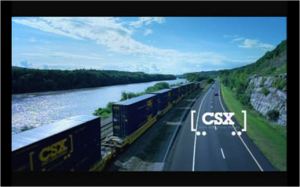
Closing image from a CSX commercial

This is a compelling image but not necessarily in the way intended by the folks at CSX.

For good reason I’ve heard many people credit CSX for the quality of its television commercials.  Norfolk Southern and the collective Class I industry also have put up very effective ads that have been running for a few years.   The message is exceedingly simple.  On a ton-for-ton basis rail is a fuel efficient and low carbon-footprint way to move lots of freight now traveling on the highways.

The ads are shown repeatedly in this D.C. market because this is where policy makers and influencers are.   The railroads want Congress to approve a targeted 25%  tax credit for their infrastructure investments.  They also know that new climate and energy policies could affect their bottom line.   So the industry is investing  millions to instill a favorable public image.  It is working.  Green groups are lobbying for more freight trains and fewer trucks.

As an admirer of the ad campaign I use this image in presentations about the need for marine highway policy.  The ad accomplishes two things for those of us who think that the even greater efficiency of marine transportation deserves equal attention.

First, it graphically reveals the availability of waterside capacity for the surface transportation system.  It is hidden capacity, metaphorically speaking, when early in the commercial the focus is on containers lifted from the congested roadway to the nearby train.  Then our last view is of a waterway so uncongested as to be empty of vessels.

Second, it serves as a challenge to the maritime industry, which  can top the railroad claims about fuel efficiency.   The tug and tow companies have undertaken a modest general ad campaign to carry that message.  However that AWO effort is the only one.  The present and future marine highway–including the capacity of ships to carry trucks themselves–remains a hidden asset because the larger industry isn’t telling the story.

There is no comparing the resources of the rail and barge industries.  So don’t look anytime soon for a comparable televised promotional effort by vessel operators.  Nor have I seen signs that the broader maritime sector is ready to pool resources to promote the marine highway to Washington.

If the public and the policy makers are to learn about the advantages of marine transportation and the potential for addressing some of the nation’s growing transportation challenges it will happen when the maritime sector comes together to carry that message.   The railroads can’t be counted on to place more subliminal maritime messages on TV.  Pbea

Report on Freight Funding Policy

In Federal Government, Infrastructure on September 2, 2009 at 4:50 pm

The TRB has a new report that is worth a look:  Funding Options for Freight Transportation Projects. The study committee was charged with examining the rationale for public investment, evaluating financing strategies for “freight transportation projects of national significance,” assessing the ability to use criteria  in project selection,  and evaluating and comparing “generic financing options…based upon the greatest net benefit and least cost per public dollar invested.”  Here is a summary of the broad categories of recommendations along with a sampling of specifics:

  • Federal freight infrastructure assistance programs should adhere to certain guidelines. Project earmarking “weakens the effectiveness” of programs; any program should be structured to address freight projects on a case-by-case basis and be “flexible to address diverse assistance needs.”
  • Create a new discretionary assistance program to support freight projects, starting with a “test of the need for and value of a responsible and flexible federal program…” The “test” would be $1.8bn over 4-6 years and an independent evaluation to determine the program’s worth.  Note: the program outlined in the report is in many ways similar to the multimodal “TIGER” grants USDOT was charged with administering in the economic stimulus bill enacted last February.  Applications are due Sep15 and selected projects announced in Feb.
  • Make credit assistance more accessible and attractive to freight projects that merit Federal support. Includes revisions to TIFIA; encourage private sector participation by changing tax laws to be “neutral with respect to private versus public management” and finance “the kinds of facilities that commonly are built by the public sector.”
  • Reduce barriers to the development of local and facility-specific revenue sources to pay for freight infrastructure capital costs and provide incentives to encourage use of such sources. Enable port authorities to impose cargo charges “for purposes of  providing revenue for construction and operation of port facilities and access routes…”; reduce barriers to foreign ownership, operation and investment in the transportation industry, “particularly maritime and aviation…”
  • Expand the capability for freight system planning, project evaluation and data collection. Establish a “discrete…home for the functions of project evaluation, performance monitoring and technical assistance to state and local governments;”  develop a “continuing, comprehensive, and systematic program to monitory performance of the national freight transportation system…”

Bill Sez “Nah” to Funding Ports/Freight with NII

In Federal Government on August 4, 2009 at 11:29 pm

Interesting.  When in February Congress sent the huge economic recovery package a.k.a. ARRA, to the White House for signature many folks were pleased that it contained a new $1.5bn multimodal discretionary grant program for the  Transportation Secretary to allocate.  House and Senate appropriators are not known for giving department chiefs  large sums  of money to spend on this or that.  Nor has Congress been in the habit of allowing the Office of the Secretary (OST) the discretion to grant funds outside the tightly prescribed modal grant programs and, for that matter, for projects not already earmarked.  So, when the authority to spend $1.5bn was sent to Secretary Ray LaHood  observers knew much was at stake.  Might this open the door to additional multimodal appropriations or to a new program that would be included in the eventual successor to SAFETEA-LU?

Just a few months later we have a partial answer.  Senate Appropriators included in the FY 2010 DOT spending bill (HR 3288) yet another, but not identical, multimodal discretionary grant program.  This time it is $1.1bn for National Infrastructure Investments (NII).  It seems to resemble the $1.5bn pot that Secretary LaHood has dubbed TIGER grants–applications for which are due at USDOT September 15th.  The Senate committee summary indicates the grants are “to support significant transportation projects in a wide variety of modes, including highways and bridges, public transportation, passenger and freight railroads, and port infrastructure.”   But according to Jeff Davis of the very reliable Transportation Weekly the intent is not to support certain port and freight related projects that are outside of the Title 23 (highways, etc) and Title 49 (transit) eligible project categories.  Jeff says it does not include this TIGER grant language from the stimulus bill that opened the door to “port infrastructure investments, including projects that connect ports to other modes of transportation and improve the efficiency of freight movement.

Wading in more deeply…here is where it is a bit confusing.  Title 23 eligible projects do include some freight related projects such as “intermodal transfer” and “public freight rail” facilities. As for ports  Title 23  even includes (but limit  eligibility to) certain projects within a port terminal’s gate that facilitate the “direct intermodal interchange, transfer and access” in and out of the port.  So how does that differ from the underlined above?   Maybe the answer is somewhere in this supplemental description of the TIGER grant program that would invite, for example, vessel projects that otherwise meet TIGER grant criteria.

So, why NII and not TIGER II?  Could this represent some disapproval of  the Secretary’s recent encouraging words to the effect that TIGER grants enable a change in policy that to date has offered port/maritime related infrastructure little or no Federal program assistance?  Let’s hope not.  More to learn.