Marine Transportation System

Posts Tagged ‘marine highways’

Rendell Bets on a Delay

In Infrastructure, Surface Transportation Policy on September 25, 2009 at 7:44 am

Governor Ed Rendell, a leading figure in the call for infrastructure reform and investment in the U.S., said that any surface transportation bill that Congress could pass this year would be a “very mediocre bill in terms of the needs of the country.”

In a story yesterday by Bob Edmonson of the Journal of Commerce the governor acknowledged, “In one sense a delay is hurtful, but in another sense the delay would give us a chance to look at new ideas, and build new concepts, and try to get a bill that will really revolutionize.”  Rendell spoke at a American Road and Transportation Builders Association conference.

The governor apparently assumes that the Senate and Administration will succeed in getting an 18 month extension of  the expiring SAFETEA-LU.  Chairman Jim Oberstar (D-MN) on the House side doesn’t want to put off major revenue and policy decisions that long.

On September 23rd when the House debated, and passed, a three month extension, through December, Steven LaTourette (R-OH) agreed that action is needed now.  His House Republican leadership opted to object to a prospective gas tax hike, which was not even on the table, rather than identify themselves with the need to maintain highway and transit programs.  LaTourette stood in the well–exasperated, looking at his own party members–and said, “I am constantly amazed at how both parties are able to snatch defeat from the jaws of victory.”  He foresees his party in the months ahead fighting a major transportation bill in the cause for low taxes.

In a recession the desire to improve the economic environment for employment is genuine and politically vital.  It’s easy to understand the impatience.  Oberstar and others want to move as quickly as possible to produce a 5-year, $450 Bn transportation bill.   Then again, there is that knotty problem of how to pay for it, as noted in this prior posting.

Whatever other thinking may be behind Governor Rendell’s frank remarks to the “road builders” he makes an important point.  On the surface is this one:  Jim Oberstar may be ready to move a bill but the Senate and administration are not.  But Rendell seems to go deeper than that.  Crafting a major bill, with its inherently difficult revenue issues and bearing the weight of expectations that this one must break new policy ground, will take more time.

Rendell is right.  After reaching the pinnacle that is SAFETEA-LU we don’t need another “mediocre” bill.   The hearing record of recent years is loaded with testimony calling on Congress to not repeat past mistakes and, as the governor put it, to produce “a bill that will really revolutionize.”  Freight policy, high-speed rail, transportation policy in a new energy/environment policy framework, performance measures, marine highways, livable communities, and the broader question raised by the Secretary as to how to integrate the MTS more fully into surface transportation policy.  These are just some of the policy challenges.

The Oberstar bill is a clear step in that direction.  And while the Senate committees have been plotting their TEA contributions the administration can’t say the same.  The White House and the Department of Transportation, which remains immersed in implementing the economic stimulus package with its multi-billion dollar new programs,  are nowhere near ready to be a full participant in the crucial dialogue on next generation surface transportation program and policy.  It will take more time.   Pbea

Our Turn to Pay the Freight

In Infrastructure, Surface Transportation Policy on September 9, 2009 at 5:21 pm
PBS "Blueprint America" Documentary:  "Keep on Trucking?"

PBS "Blueprint America" Documentary: "Keep on Trucking?"

Blueprint America is the PBS infrastructure series.  The series is one of the best I have seen on the subject, not that there is much competition on TV in this category.  Keep on Trucking? has the virtue of being taped in my Garden State, where men are men and women are truck drivers who train the men.

The segment reported by Miles O’Brien covers our reliance on trucking and the 50+ year old interstate highway model.  He reports on the benefits and limitations of the rail freight system.  He covers how trucking and rail compete and cooperate (“the term of art is intermodal”).  He introduces community concerns via New Jersey’s Ironbound, which is adjacent to the Newark container terminals.  And O’Brien overlays the  fact that Congress will have to replace SAFETEA-LU and face the political conundrum of taxes, with Jim Oberstar’s (D-MN) foot on the House accelerator.

Part of the value of this particular “…Trucking?” segment, as one individual awkwardly said, is the need “to look at the network of this nation as a whole” and “how these two modes can be interfaced in the most efficient way”.   “A freight relay if you will,” Miles O’Brien added, “… trains and trucks each doing the part of the job they do most economically, then passing the baton.”

Of course that topic deserves a 24-minute segment of its own…but not one limited only to two surface modes.

Predictably marine transportation was not mentioned.  Considering the key points made in the piece the marine highway should have been included in the “network of this nation.”  The water mode applies to the ideas of intermodal operation, efficiency, congestion mitigation, and the need to think outside the 1950s highway model.  As one voice noted, “it’s about retooling the freight infrastructure so American business can compete in the global marketplace.”  Not about maintaining the primacy of road and rail, one might add.

Miles O’Brien alluded to the fact that arriving at a new policy will not be easy.  “There is no love lost in the fight over infrastructure dollars.”  Bill Graves of the American Trucking Association asserted that the public shouldn’t be “deluded” that rail is “the answer”…the Association of American Railroads‘ ad campaign notwithstanding.

O’Brien expressed no particular confidence that Congress will adopt a new model.  He spoke of an American consumer trait, taking things for granted–“plentiful, high quality goods, delivered fast and cheap”–and made possible seemingly “like magic.”  Not willing to make it easy on voter or legislator, he said “it is actually about planning ahead and making big investments.”  The generation that built the interstate system did it.  “Now it may be our turn to pay the freight.”   Pbea

Rail Shows the Way to the Water

In MTS Policy on September 3, 2009 at 8:27 am
RiverRailRoad

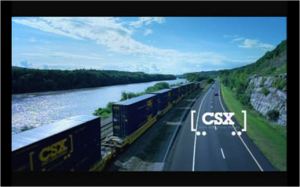
Closing image from a CSX commercial

This is a compelling image but not necessarily in the way intended by the folks at CSX.

For good reason I’ve heard many people credit CSX for the quality of its television commercials.  Norfolk Southern and the collective Class I industry also have put up very effective ads that have been running for a few years.   The message is exceedingly simple.  On a ton-for-ton basis rail is a fuel efficient and low carbon-footprint way to move lots of freight now traveling on the highways.

The ads are shown repeatedly in this D.C. market because this is where policy makers and influencers are.   The railroads want Congress to approve a targeted 25%  tax credit for their infrastructure investments.  They also know that new climate and energy policies could affect their bottom line.   So the industry is investing  millions to instill a favorable public image.  It is working.  Green groups are lobbying for more freight trains and fewer trucks.

As an admirer of the ad campaign I use this image in presentations about the need for marine highway policy.  The ad accomplishes two things for those of us who think that the even greater efficiency of marine transportation deserves equal attention.

First, it graphically reveals the availability of waterside capacity for the surface transportation system.  It is hidden capacity, metaphorically speaking, when early in the commercial the focus is on containers lifted from the congested roadway to the nearby train.  Then our last view is of a waterway so uncongested as to be empty of vessels.

Second, it serves as a challenge to the maritime industry, which  can top the railroad claims about fuel efficiency.   The tug and tow companies have undertaken a modest general ad campaign to carry that message.  However that AWO effort is the only one.  The present and future marine highway–including the capacity of ships to carry trucks themselves–remains a hidden asset because the larger industry isn’t telling the story.

There is no comparing the resources of the rail and barge industries.  So don’t look anytime soon for a comparable televised promotional effort by vessel operators.  Nor have I seen signs that the broader maritime sector is ready to pool resources to promote the marine highway to Washington.

If the public and the policy makers are to learn about the advantages of marine transportation and the potential for addressing some of the nation’s growing transportation challenges it will happen when the maritime sector comes together to carry that message.   The railroads can’t be counted on to place more subliminal maritime messages on TV.  Pbea

Transformational Transportation, Part 2

In Green Transportation on July 31, 2009 at 11:21 pm

Persons famliar with Secretary LaHood’s meeting with public and port officials in Oakland tell me that folks might be surprised to know which California official was most enthusiastic  about the prospects for Bay Area marine highway service.  Among those at the meeting were two California cabinet members (Food & Agriculture and Business, Transportation & Housing) and the director of Caltrans.

The Eco Transport project has been in development for a few years.  The business plan is to reduce the need for  truck moves into Oakland by deploying barges to move containers between Oakland and the Ports of Stockton, initially, and Sacramento.  The company notes that such an operation also will make unnecessary a great many empty container moves and the associated costs of fuel and exhaust.   Export containers could be loaded heavier in Stockton because they would not have to meet road weight restrictions.  And carbon counters are sure to like the shrinking of the significant carbon footprint of trucks carrying imports into the central region, and California exports to Northern California’s principal international gateway.  Indeed the company has done its due diligence to substantiate the environmental benefits of their new marine highway service.  And the result has been the endorsement of regional and State air quality agencies.

So which official at the meeting revealed great eagerness and anticipation about the green barge service?  It was Food and Agriculture Secretary A.G. Kawamura.  He and the growers/shippers of the Central Valley are enthusiastic about the prospects for barges carrying goods to Oakland and then on to a ship for the export market.  And when a shipper is looking forward to taking  its goods to the water that’s a very encouraging sign.

LaHood: Marine Highway as Transformational

In Ports on July 27, 2009 at 2:24 pm

DOT Secretary Ray LaHood was in Oakland on July 2nd talking freight and ports.  He was importuned by local, State and Federal office holders about the need for a national goods movement policy.  He was told that infrastructure improvements strengthen the capacity of ports to serve the nation.  He  heard them say there’s a need for equity among West Coast ports.   He volunteered that a California “ports czar” might be what’s needed.  (Although that may not be what the folks in Oakland have in mind.)

He also reiterated his view that marine highway development should be realized and would be “transformational.”  His tweet from Oakland: “US ports provide transportation for the 21st century.”

The key to creating more environmentally friendly ports, LaHood said, is to transport more goods by ship rather than trucks. He mentioned, in particular, the importance of a “marine highway” along the West Coast. “We will be putting a good deal of emphasis on the marine highway in order for us to get trucks off the road and get cleaner air,” LaHood said. (Source: Chris Metinko, Oakland Tribune)