Marine Transportation System

Posts Tagged ‘Ports’

California Trailblazing to a Miami Tunnel

In Intermodal, Ports, Surface Transportation Policy on November 17, 2009 at 11:04 pm

When earth was turned in 1997 for the Alameda Corridor project in the San Pedro Bay port region more than one kind of ground breaking was occurring.  The Port of Miami is a beneficiary.

In freight transportation policy circles the Alameda Corridor project one day may be legend.  The ports of Los Angeles and Long Beach were the gaping end of a freight funnel that emptied import boxes onto the exit rails and streets.  In essence the solution was to eliminate grade crossings by building a blow-grade rail way out of town.  A big project with a $2.4B price tag.  A key to the financing was Federal credit assistance.  The project and two others in California were the first to benefit by this innovation.  A paper on the FHWA website tells the story.

Due to Federal budgetary constraints, however, the grant was not deemed to be a fiscally or politically viable option. An alternative form of Federal support for this project was needed, and by 1997 the answer was clear: Federal credit enhancement in the form of a junior-lien loan to ACTA.

The fiscal year 1997 Omnibus Consolidated Appropriations Act (Public Law 104-208) provided $58.7 million for DOT to cover the capital reserve charges associated with making a direct loan of up to $400 million to ACTA for the Alameda Corridor Project. This represents an actual budgetary cost of 14.7 percent of the face value of credit assistance. The legislation also provided that the loan be repaid within 30 years from the date of project completion and that the interest rate on the loan not exceed the 30-year Treasury rate.

Inspired by the success of leveraging non-Federal investment for large infrastructure project, particularly private financing, Congress in 1998 fashioned a fully articulated TIFIA program.  It was adjusted in SAFETEA-LU with a lowered threshold to make more projects eligible.

Nearly $7 billion in projects in 13 states have benefited since TIFIA was created by Congress.  The Port of Miami’s rail freight tunnel had an uncertain future but with the October announcement the financing is in place and a $607 million construction project soon will be underway.  Not bad.   Pbea

.

Ports on the Secretary’s To-Do List

In Federal Government, MTS Policy on November 8, 2009 at 11:49 pm

The DOT Secretary’s blog–Fast Lane–noted this past Thursday that “port managers have a difficult dual mission to fulfill-–providing the critical interface between water and surface transportation, while handling both commercial and military cargo.”  The prior day he met with the National Port Readiness Network, including some port representatives.

Secretary Ray LaHood acknowledged in his blog that that dual mission “is much easier said than done. ”  “And I get that only the commercial side of their mission provides the ports compensation.”  He said “DOT wants to do all we can to help them meet these obligations.”

Back in March when Secretary LaHood addressed the spring meeting of the American Association of Port Authorities he was asked from the floor what the new administration was thinking in the way of a freight policy.  The cabinet member said his department had yet to give it attention, that implementation of the stimulus package was USDOT’s  immediate focus, and toward the end of the year he may convene stakeholders to start to develop a perspective on freight.

It sounds like he is ready to act on that idea.  In recent weeks he indicated to Kurt Nagle of the AAPA that USDOT will call port directors together for purposes that include an examination of freight issues.  The plan is to have a meeting–perhaps in New Orleans–this coming January.

He noted in this blog of November 5th two action items–a “port summit” and “a Presidential initiative to integrate planning” with DHS.

The former appears to be focused on the port authorities–the public agencies with port jurisdiction.  A government to government conversation makes sense.   But will the Secretary at some point also enlist the private sector side of the ports–the terminal and vessel operators–in a confab to examine freight issues?  And will this be the start of a concerted effort in the Secretary’s office to develop an overdue Federal freight policy?

The latter is a reference to a $15M item in the current year budget–also in the Senate version of the DOT appropriations bill.  “This will help develop and modernize the freight infrastructure that links coastal and inland ports to highway and rail networks,” LaHood said in the blog.  We’ll have to wait and see how that  intention will materialize in actual projects.  Earlier this year MARAD folks said that some or all of it may be applied to marine highway initiatives.

We’ll see how these two items on the Secretary’s to-do list develop.  In the mean time it’s good to know that Secretary LaHood wants to listen to the ports and focus some resources on the MTS.   Pbea

Next WRDA a Policy Bill?

In Infrastructure, Water Resources on November 3, 2009 at 3:29 pm

WRDAlite2

WRDA (say “wurr-da”) sometimes is an elusive, even mythical, thing.  When it appears out of the Capitol Hill mist–like Brigadoon–it’s not with the reliable–albeit once-in-a-hundred years–clockwork of that fabled village.   It is usually defined as a biennial water resources authorization bill but it rarely takes such predictable, finished form as a president might come to expect on his desk every two years…assuming he wants it there.

Part of WRDA lore (and lure) is that it is tailor made for end-of-congress action on the eve of congressional elections.  Before returning home Members would wrap up the bill and their press releases touting what WRDA holds for their districts.  For, above all, a Water Resources Development Act is a projects bill.  Indeed part of the legend–not without  good reason–is that for WRDA to get through Congress it must be laden with projects.  No projects, no critical mass.  No critical mass, not enough aye votes.

WRDA 2007, the most recent version made law, was propelled in part by the huge Everglades project.  It was not without controversy but as an environmental restoration project the Everglades project gave the bill essential critical mass and acceptability among many in the environmental community which often is critical of project bills.

Legislators submit their wish lists.  Even many Members who disdain the practice of earmarking.  Port channels.  Beach replenishment.  Flood control.  Environmental projects…these ever more so.  They include wastewater treatment, water supply and the like.

The foundation of any WRDA is projects that move “through the pipeline,” much as the Everglades restoration project did.  They are subjected to Federal feasibility and environmental studies and then Secretarial and White House review.  An interminable process to some.  Projects exit the pipeline, usually, as recommendations for formal authorization,  WRDA being the next step in a civil works project’s journey through government.

When it comes to critical mass, it looks as if WRDA 2010 could end up WRDA Lite.  Fewer projects and lower cost.  So far only a couple of projects have emerged from the pipeline.  Some folks suggest we may have more of a WRDA policy bill than a projects bill.  That’s possible.

As one example, ports have wanted the law changed to secure the Harbor Maintenance Trust Fund.   Harbor Maintenance Tax revenues go into the general treasury and only around 60 percent of the proceeds actually are spent on channel maintenance.   There’s meat for a WRDA.

We will have to see whether there will be sufficient oomph of any sort to power this next WRDA.  We may get a clue later this month.  The House Water Resources & Environment Subcommittee will hold its first WRDA hearing  on November 18th. Pbea

A Slice of Pie for Hungry Ports

In Infrastructure, Ports on October 13, 2009 at 11:25 pm

I’m not sure if this is a troubling sign but Sally Fields comes to mind when I think of TIGER grants.

Those are the multi-modal, discretionary grants that were created in the economic stimulus bill Congress approved last February.  The pleased folks at USDOT dubbed the program TIGER–a suitable acronym–and put flesh on the bones. Pleased because this was one of those rare times when Congress was willing to say: “Here, Mr. Secretary, is 1,500,000,000 dollars for you to spend, outside of existing modal grant programs, at your discretion.

There were some rules of course, but none of the earmarked projects Congress is so fond of TIGERpiedesignating to the fullest extent of available funds.

And with a reform-oriented SAFETEA-LU sequel due to be written by Congress it was not lost on USDOT that if the TIGER program were managed well–whatever “well” might mean to congressional overseers–it could be a model for replication.  USDOT may be entrusted to award more competitive grants on the basis of project merit and worth to the country.  Imagine that.  (Indeed, the Senate DOT appropriations bill for FY 2010 includes $1.1 Bn for additional TIGER grants.)

In the months that followed enactment of the $750 Bn stimulus package–some $48 Bn of which was allocated to USDOT for near term implementation–Secretary Ray LaHood told port officials and others involved in the MTS that port project applications would be welcomed for TIGER grants.  He told the D.C. Propeller Club audience in May that the maritime sector has been neglected and TIGER grants were an opportunity.

Well, the ports listened.  Shades of Sally Fields!  When in 1985 she won her second golden statue for her role in Places in the Heart the former “Flying Nun” famously cried, “You really like me!”

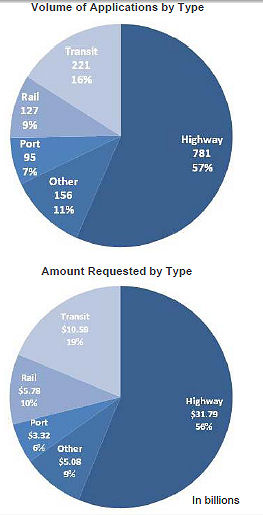
The ports took to heart the Secretary’s encouragement. He really wanted them to apply for grants and apply they did.  Ninety-five applications were submitted for port related projects totaling $3.3 Bn.  Certainly the smallest of the modal slices on the pie chart, but not an overwhelming difference when compared to rail.

Toward what end?  We’ll learn in February what projects are approved and how many are for ports.  The TIGER grants and pending legislation to grant MARAD infrastructure improvement authorities are signs that change may be in the wind.  The Feds are becoming more open to assisting ports with more than just channel construction and maintenance.  Certainly MARAD is eager to claim new program areas.  And some of the ports, perhaps an increasing number, are welcoming the help of Uncle Sam…maybe even inside the gate.   Pbea

Will Ports Be Ready? (Part 3)

In Efficiency, Ports on September 17, 2009 at 11:22 pm

Will U.S. ports, especially those on the Atlantic and Gulf coasts, be ready to operate in the changing domestic and international commercial environment? With major shifts on the way the ports that adequately prepare will be the ones to maintain and gain market share.  A shift in buying power—where the consumers are—may be the greatest change facing major gateway ports throughout the U.S.

Consumer Demand
The primary end-consumer of manufactured goods is shifting east—Far East.  For U.S. ports, it is going to be as important to be an efficient “export port” in the coming decade as it was to be an efficient “import port” last decade.

Over the last decade a significant shift in national and individual wealth occurred from America and Europe to the Far East and India.  In the next several decades the emerging middle classes in China and India will be the primary global goods and services consumers.  China already has a middle-class of 300 million, approximately the same number as the U.S. total population.

An increasing demand for goods will be driven by two phenomena: population growth and economic convergence.  The world population (currently at 6.8 billion) is expected to reach 7 billion in late 2010 and to reach 8 billion within 20 years, or sooner.  (Much of this growth will be in Asia and Africa, but by 2050 it is projected that India will be the world’s most populous nation.)

Approximately 80 percent of these new individuals will have discretionary incomes nearly equal to their western counterparts because of increasingly convergent economic patterns for most nations.  Meanwhile western-populations will age and increase their savings rates in order to provide for their retirement years.  In short, the demand will be on the other side of the planet.

The Bottom Line
U.S ports planning to participate in the international trade and transportation business will have to be agile, 2-directional (serving both imports and exports), environmentally sound operations, and take advantage of economies of scope and scale to compete in the 21st Century.  These are business considerations that should be included in a port’s strategic business plan to maintain and gain market share.

T. H. Wakeman

Will Ports Be Ready? (Part 2)

In Environment, Ports on September 15, 2009 at 5:14 pm

Will U.S. ports, especially those on the Atlantic and Gulf coasts, be ready to operate in the changing domestic and international commercial environment? With major shifts on the way the ports that adequately prepare will be the ones to maintain and gain market share.  The change in environment—at local, national and global levels—will be a constant factor not easily addressed.

Environmental Concerns
From 2002 to 2007 many ports found it necessary to have a proactive environmental policy to get community approval to operate and expand.  Most major ports experienced double digit volume increases that resulted in problems with surrounding communities over increasing road congestion, noxious air emissions, and safety concerns.  In the San Pedro Bay ports communities voiced their anger to local politicians and in short order port projects were put on hold.

With the collapse of global trade, the pressure subsided as the number of containers and trucks decreased.  However, all indications suggest that world trade will rebound and cargo volumes will double by 2040.  Community concerns and political problems will re-emerge as well.  Other environmental issues may also emerge to affect port business practices—consumption of non-renewable resources, bio-hazards, and concerns about species redistribution that may persist even with ballast water regulation.  A proactive policy may again be a necessity for certain major ports if their environmental performance is seen as problematic for their neighbors.

Green house gases (GHG) are probably going to be the biggest environmental game changer for businesses as climate change policy is put in place and businesses calculate the added expense.  The U.S. contributes 20 percent of the world’s emissions from burning fossil fuels; India contributes 4 percent.  Will there be a carbon tax or cap and trade policy established worldwide?  What will be the cost penalty for oceanborne cargo here or worldwide?  How fast will engine room and terminal equipment technology adapt?  Those questions await answers and clarification.

As climate change concerns and political acceptance addressing those concerns increase, the pressures to aggressively address GHG will be enormous.  (That is likely notwithstanding the relative environmental and energy per-ton/mile efficiency of the marine and rail elements of MTS related transportation.)  These issues will have even greater impacts on the cost of ports, particularly if dealt with retroactively.

Next: Consumer demand and the bottom line.

T. H. Wakeman

Will Ports Be Ready? (Part 1)

In Infrastructure, Ports on September 13, 2009 at 10:15 pm

Will U.S. ports, especially those on the Atlantic and the Gulf coasts, be ready to operate in the changing domestic and international commercial environment? With major shifts on the way the ports that adequately prepare will be the ones to maintain and gain market share. Cargo flow volumes will shift in a big way.  This is the first of a three-part observation by our new contributor Thomas H. Wakeman III, Eng.Sc.D.

Panama Canal
The one approaching shift that escapes no port’s attention is the Panama Canal.  The Panama Canal Authority is investing $5.3 billion to widen and expand the canal’s capacity to service the current generation of 8000+ TEU container ships.  When the new locks open in 2014, a new era will begin.  It could change global trading patterns just as the initial canal opening did in 1914.

As much as 25 percent of today’s West Coast cargo base could be transferred to East and Gulf Coast ports as global trade picks up again.  There will only be one chance to gain control of the initial surge.  It will be the deepest East and Gulf Coast ports with corresponding intermodal connections and warehousing capacity that will capture this shift in market share.

Economies of Scale/Scope
Achieving economies of scale and scope will determine the mega-players.  It started with increasing ship size first among the bulk carriers and then emerged with the container carriers in the latter part of last century to secure economies of scale.  Because margins are razor thin only ports and their supporting infrastructure systems (whether as import or export corridors) with sufficient capacity and efficiency effectively will compete and perform in the global marketplace among the major “port poles”, forming as collaborative networks in Asia, India, and Europe to achieve economies of scope.

These port poles, which combine the infrastructure and business services of more than one port into a mega-region logistics platform, have the ability to be agile, cost-effective and resilient when shocks occur.  They are seen as reliable routes by shippers – giving them agile and flexible networks.

Infrastructure
Time and reliability are the watch words for global business.  As goods flow across the world’s oceans, through our ports, and connect to domestic corridors, they face time delays in route and uncertainty about ultimate delivery schedules because of infrastructure capacity constraints.  Freight must flow seamlessly or there is a time, cost and reliability penalty.

India plans to increase infrastructure spending to 9% of GDP (an estimated $500 billion) by 2014, up from the current 4%, on roads, ports and airports.  In China, according to the Asian Development Bank, the figure is close to 10% GDP for 2008-2009.

The US has been living on its past construction accomplishments.  According to the Congressional Budget Office, between 1984 and 2004, the U.S. capital investments (including federal, state, and local) averaged less than 1.2% GDP.  Our growth of demand and lack of investment was unsustainable.  Without the recession, we would have been overwhelmed by traffic, much less prepared for what is going to be demanded in the next decade.   Our infrastructure systems can not deliver what business is going to require for maintaining global competitiveness without significant investments.

Next: Environmental Concerns

T. H. Wakeman

Report on Freight Funding Policy

In Federal Government, Infrastructure on September 2, 2009 at 4:50 pm

The TRB has a new report that is worth a look:  Funding Options for Freight Transportation Projects. The study committee was charged with examining the rationale for public investment, evaluating financing strategies for “freight transportation projects of national significance,” assessing the ability to use criteria  in project selection,  and evaluating and comparing “generic financing options…based upon the greatest net benefit and least cost per public dollar invested.”  Here is a summary of the broad categories of recommendations along with a sampling of specifics:

  • Federal freight infrastructure assistance programs should adhere to certain guidelines. Project earmarking “weakens the effectiveness” of programs; any program should be structured to address freight projects on a case-by-case basis and be “flexible to address diverse assistance needs.”
  • Create a new discretionary assistance program to support freight projects, starting with a “test of the need for and value of a responsible and flexible federal program…” The “test” would be $1.8bn over 4-6 years and an independent evaluation to determine the program’s worth.  Note: the program outlined in the report is in many ways similar to the multimodal “TIGER” grants USDOT was charged with administering in the economic stimulus bill enacted last February.  Applications are due Sep15 and selected projects announced in Feb.
  • Make credit assistance more accessible and attractive to freight projects that merit Federal support. Includes revisions to TIFIA; encourage private sector participation by changing tax laws to be “neutral with respect to private versus public management” and finance “the kinds of facilities that commonly are built by the public sector.”
  • Reduce barriers to the development of local and facility-specific revenue sources to pay for freight infrastructure capital costs and provide incentives to encourage use of such sources. Enable port authorities to impose cargo charges “for purposes of  providing revenue for construction and operation of port facilities and access routes…”; reduce barriers to foreign ownership, operation and investment in the transportation industry, “particularly maritime and aviation…”
  • Expand the capability for freight system planning, project evaluation and data collection. Establish a “discrete…home for the functions of project evaluation, performance monitoring and technical assistance to state and local governments;”  develop a “continuing, comprehensive, and systematic program to monitory performance of the national freight transportation system…”

When State Regulation is Invasive

In Federal Government on September 1, 2009 at 5:24 pm

Non-indigenous species carried in ballast water (graphic by Patterson Clark of the WPost)

Non-indigenous species carried in ballast water (graphic by Patterson Clark of the WPost)

The Coast Guard issued on August 28th a proposed rule for the regulation of ballast water discharges (BWD).  This is the Nagging Problem (NP) that has plagued the maritime sector, particularly vessel operators.  That problem is both the habitat devastation caused by non-indigenous aquatic species unwittingly carried here from foreign ports and the  patchwork of regulation that can confound those responsible for ships in commerce.

Two Federal agencies claim jurisdiction.  The EPA does, per the Clean Water Act, and through that several states  exercise delegated authority to protect their waters.   So states like California, Michigan, Washington, and New York set their own requirements for vessels to meet.

But the vessels in question don’t just putter around Lake Erie, so to speak.  They transit international waters in international commerce and call in multiple ports.  The proposed Coast Guard rule takes a national approach with an international foundation for starters.  The proposed regs  would establish a standard for allowable concentrations of organisms in BWD.  The standard and schedule are consistent with the applicable IMO convention.  In the next decade, the standard would tighten significantly–assuming you think 1000x is significant–if currently unavailable technology would become available.  (Comments on the regulations are due November 27th.)

Still, there is that other NP.  The complication of multiple standards courtesy of the states.   At present Federal law doesn’t preempt non-Federal standards though that would be a good idea.  Who is to say that the means to meet one standard can also satisfy a second or a third standard as a ship moves from port to port?  And what if the State standard isn’t…well…carefully considered?

New York’s regulation, effective 2012, will put a ship’s pilot in violation of the law if the ship, lacking a means to meet the standard, crosses New York waters (without discharging) on its way to a terminal in New Jersey.  As frustrating  is the stricter-than-IMO standard for which ships must have onboard environmental technology that has yet to be devised, not to mention shown to be safe and effective.  NYDEC does not allow for an absence of applicable technology.  Take this enlightening discussion from The Washington Post story of August 31

Steve Fisher, executive director of the American Great Lakes Ports Association, called different regulations in each state a “nightmare scenario.” He said current technology cannot meet New York’s standards, which are 100 times stronger than the IMO treaty, and he expects that the state will have to close ports or relax its rules.

Jim Tierney, assistant commissioner for water resources at the New York State Department of Environmental Conservation, disagreed. “It’s not that hard to kill things,” he said. “You can heat them up, crush them, pressurize them, put a chemical on them. We think this is a problem that can be solved in a very economical fashion.”

Well, there ya go, naval architects, biologists and others who have been working this question for a good many years.  Maybe it’s not so difficult after all.  Maybe just a big hammer, goggles, and a trash bag will get ‘er done.   Pbea

New York Harbor High

In Education on August 24, 2009 at 12:29 pm

A number of years ago a colleague at The Port Authority of New York & New Jersey came up with the idea of a board game for area schools.  It would be used to teach kids that one the world’s great seaports was  a short distance away.   Few people in the region understood that the Port was a major economic generator for the two States.  Where Wall Street, Broadway, The Village, the Jersey Shore, and The Sopranos were well known economic generators we found ourselves envying other, smaller ports that were valued, centers of hometown interest.

So staff in the port department developed the board game and produced boxed versions as one element of a public relations effort.   Many hours went into designing the game board to serve its education purposes.  To  the credit of those who worked on it the board didn’t look like one of the countless Monopoly knock-offs. Years later a sample of the game board is one of several keepsakes in my office.  Those game boxes probably share a similar, perhaps inevitable, dusty fate in teacher closets.  Thankfully the imperative to educate kids about their port didn’t end there.

The New York Harbor High School has a greater chance of producing a population of kids who will better understand the natural harbor and the commerce taking place there.  This publicly supported school and its roughly 400 students are moving into a new facility on Governors Island, which is as great a front porch as any from which to soak in the benefits of a harbor.   The kids will benefit by a curriculum described by the NYC Department of Education as including “Marine Technology, Marine Science, Environmental Policy, Maritime Culture and History, Computer Aided Design (CAD), Swimming, Senior Internships at maritime and water-related businesses throughout the New York City area” and more.  Teach your children well.  Pbea