Marine Transportation System

Posts Tagged ‘Ports’

The Grass is Greener – Pt.1

In Federal Government on August 19, 2009 at 11:23 pm

Envy is a perfectly serviceable starting point for developing national transportation policy.  Our new high-speed rail program is an apt example.  It’s a Euro-inspired, greenish gleam in a candidate’s eye made billion-dollar real by our new president and the stimulus package.  While we wait for our first bullet-ride to Disney World or Albany let’s consider what the national transportation policies of other countries are accomplishing. We will start with our friends to the north who want Canada to be the continent’s gateway.   To Memphis.
Canada Gateways

The Canada’s Gateways program is impressive.  Watching a visiting transportation official give a presentation on it is like listening to a nice kid tell of his elegant plan to steal your lunch.  As he speaks it sinks in that you will go hungry that day; you slowly grasp your trumpet case to make sure he doesn’t walk away with it also.  The adult response is to admire the strategic thinking and implementation…while watching one’s lunch walk away.

The Asia-Pacific Gateway and Corridor Initiative is especially impressive. Short Pacific crossings by Asian cargo to new and expanded ports.  Then double stacked boxes onto improved CN and CP freight lines that run down to the American Midwest and Mississippi corridor.  Public and private money.  Public and private roles.  One national strategy.

And here’s something to make you reach for the pink stuff:  the still young Port of Prince Rupert just posted a 124% increase in containers (1st half 2009 over 1st half 2008) in one of the worst global economies ever.   That it only handled under 100,000 TEUs in these 6 months is of little consolation to US Pacific ports who face an efficient rail corridor to the north and a new canal corridor to open in Panama.

Freight stakeholders in the U.S. are pressing decision makers in Washington and gateway states to adopt favorable gateways and corridors policies to address national goods movement needs on all coasts.  Lucky for them inspiration is just a mouse click away in the federal role discussion on the “Canada’s Gateways” website.

“Coherent action requires a systems-based approach, and real partnerships with provincial governments and the private sector. Success will depend upon how well the key players — public and private — coalesce around a coherent vision. A key factor in the successful development of the Asia-Pacific Gateway and Corridor Initiative was the extent to which a stakeholder- driven consensus had taken shape over a number of years.  ….  Actions should complement current market-oriented transportation policies, with governments creating a positive climate for private investment in gateway infrastructure, while safeguarding the public interest.”

Pbea
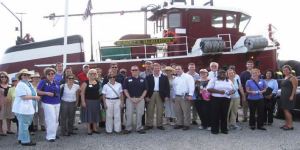

Walking the Dock and Talking the Talk

In Federal Government on August 16, 2009 at 9:19 pm

CMTS group

This week Federal agency folks caught the bus to Baltimore to see a port.   It was organized by Helen Brohl and staff of  the Committee on the Marine Transportation System (CMTS) and facilitated by Frank Hamons and colleagues of the Maryland Port Administration.  The civil servants from NTSB, ITA, OMB, MARAD, NOAA, USACE, USCG, EPA and  perhaps other offices and agencies left Washington to see elments of the MTS first hand.

Terminal operations, a NOAA survey vessel, a Ready Reserve Force ship, an intermodal yard, and a tugboat tour of the cargo and quiche sides of the waterfront.   They met with public and private sector people who keep the working port working.

From time to time one reads complaints about taxpayer money spent on public employee field trips and conference-going…as if it’s always a pleasure jaunt and never of professional value.  I’m sure that this same-day hop, just an hour up the parkway, will spark no such carping.  But that’s beside the point.  It’s a fact that trips like this one  to  the Maryland port instill more understanding than does the reading of a report.  Even one with lots of pictures.   When one is in the field the senses absorb.  The mind muses.   The discussion flows.

Washington is paying much more attention than ever to ports, shipping, and our system of logistics.   EPA regulates ballast water.   The Corps maintains channels.  TSA checks dock worker backgrounds.  NOAA decides when the dredges can work.  OSHA sets new container lift standards.   The Senate ratifies standards to lower ship emissions.  CBP scans cargo for radiation.   OMB reviews regs and budgets.  Fees are collected and new fee proposals abound.

Taking one day to take in the context for all of the above is a day and money well spent.  Kudos to CMTS and the folks in the picture.   Pbea

PORTS: Real-Time Data in Action

In Federal Government on August 9, 2009 at 5:35 pm

Want to see a government program at work?  Want some evidence you’re getting your money’s worth from your government?  Does catastrophe avoidance count?

NOAA’s Physical Oceanographic Real-Time System–or PORTS–is one of the success stories that 99.9 percent of citizens don’t hear about.   It’s a small piece of the National Ocean Service navigation services program (coastal surveying, charts, etc.).   The 18 or so PORTS installations in place so far provide commercial and government mariners, in addition to state coastal agencies and academicians, real-time tide and current data.  This is vital information, of course, but the shift from the traditional printed tide tables to accurate information from in-place sensors enables a great leap in navigation safety and  resource knowledge.  Where PORTS sensors are installed the mariner can have greater confidence in the channel ahead.  PORTS also enables crews to make air draft calculations to determine if conditions are favorable  to clear the underside of a bridge.  Whether it’s the USS New York approaching Huey P. Long Bridge or a containership facing the Bayonne Bridge on its way to Port Elizabeth  that’s a big dollar calculation.

NOS pulled together a successful pilot project in Tampa.  Among other things the technology was a means to predict oil spill behavior–a big deal in deciding spill response action.  But PORTS was getting scant or no attention in the President’s annual budget until a port/industry group knocked on the door of  the Deputy Secretary of Commerce.  They told him there was a gem buried deep in the department, starving for money and capable of saving hundreds of millions in marine accidents.

Subsequent budgets have included the bare $3mn needed to keep the system operating at HQ.  With some effort and contributions by port stakeholders, new locations slowly were connected to the system.  It wasn’t until Katrina and Rita had their way with the Gulf Coast that some Senators understood the predictive value of PORTS for a vulnerable coastline.  First realization, then a burst of funding for 4 new Gulf installations.

PORTS is a national program that remains underfunded.   Sure, there are a dozen or so port locations added since the early pilots.  But sensor installations are not uniformly the responsibility of NOAA and annual O&M funding can resemble a game of chicken when there is no firm local arrangement for funds.

This is a proven technology and system.  But without a clear Federal commitment to complete and maintain installations around the country it remains that gem lacking adequate support from the Commerce Department and Congress.

Bill Sez “Nah” to Funding Ports/Freight with NII

In Federal Government on August 4, 2009 at 11:29 pm

Interesting.  When in February Congress sent the huge economic recovery package a.k.a. ARRA, to the White House for signature many folks were pleased that it contained a new $1.5bn multimodal discretionary grant program for the  Transportation Secretary to allocate.  House and Senate appropriators are not known for giving department chiefs  large sums  of money to spend on this or that.  Nor has Congress been in the habit of allowing the Office of the Secretary (OST) the discretion to grant funds outside the tightly prescribed modal grant programs and, for that matter, for projects not already earmarked.  So, when the authority to spend $1.5bn was sent to Secretary Ray LaHood  observers knew much was at stake.  Might this open the door to additional multimodal appropriations or to a new program that would be included in the eventual successor to SAFETEA-LU?

Just a few months later we have a partial answer.  Senate Appropriators included in the FY 2010 DOT spending bill (HR 3288) yet another, but not identical, multimodal discretionary grant program.  This time it is $1.1bn for National Infrastructure Investments (NII).  It seems to resemble the $1.5bn pot that Secretary LaHood has dubbed TIGER grants–applications for which are due at USDOT September 15th.  The Senate committee summary indicates the grants are “to support significant transportation projects in a wide variety of modes, including highways and bridges, public transportation, passenger and freight railroads, and port infrastructure.”   But according to Jeff Davis of the very reliable Transportation Weekly the intent is not to support certain port and freight related projects that are outside of the Title 23 (highways, etc) and Title 49 (transit) eligible project categories.  Jeff says it does not include this TIGER grant language from the stimulus bill that opened the door to “port infrastructure investments, including projects that connect ports to other modes of transportation and improve the efficiency of freight movement.

Wading in more deeply…here is where it is a bit confusing.  Title 23 eligible projects do include some freight related projects such as “intermodal transfer” and “public freight rail” facilities. As for ports  Title 23  even includes (but limit  eligibility to) certain projects within a port terminal’s gate that facilitate the “direct intermodal interchange, transfer and access” in and out of the port.  So how does that differ from the underlined above?   Maybe the answer is somewhere in this supplemental description of the TIGER grant program that would invite, for example, vessel projects that otherwise meet TIGER grant criteria.

So, why NII and not TIGER II?  Could this represent some disapproval of  the Secretary’s recent encouraging words to the effect that TIGER grants enable a change in policy that to date has offered port/maritime related infrastructure little or no Federal program assistance?  Let’s hope not.  More to learn.

LaHood: Marine Highway as Transformational

In Ports on July 27, 2009 at 2:24 pm

DOT Secretary Ray LaHood was in Oakland on July 2nd talking freight and ports.  He was importuned by local, State and Federal office holders about the need for a national goods movement policy.  He was told that infrastructure improvements strengthen the capacity of ports to serve the nation.  He  heard them say there’s a need for equity among West Coast ports.   He volunteered that a California “ports czar” might be what’s needed.  (Although that may not be what the folks in Oakland have in mind.)

He also reiterated his view that marine highway development should be realized and would be “transformational.”  His tweet from Oakland: “US ports provide transportation for the 21st century.”

The key to creating more environmentally friendly ports, LaHood said, is to transport more goods by ship rather than trucks. He mentioned, in particular, the importance of a “marine highway” along the West Coast. “We will be putting a good deal of emphasis on the marine highway in order for us to get trucks off the road and get cleaner air,” LaHood said. (Source: Chris Metinko, Oakland Tribune)

The Sound of a Falling Container Trade (2008)

In Uncategorized on July 2, 2009 at 1:00 am

USDOT’s Bureau of Transportation Statistics (BTS) issued “America’s Container Ports: Freight Hubs That Connect Our Nation to Global Markets."   It’s a look at the container trade in 2008 and it’s effect on US ports.  The stats, including the early years of containerization, are sliced, diced and tapped for potentially usable information.

The Sound of a Falling Container Trade (2008)