Marine Transportation System

Posts Tagged ‘USDOT’

Obama Jobs Initiative: Meaning in Missing Words?

In Infrastructure, Ports on December 8, 2009 at 4:19 pm

This is what is in the president’s jobs proposal announced today with respect to infrastructure investment:

2. Investing in America’s Roads, Bridges and Infrastructure

Additional investment in highways, transit, rail, aviation and water. The President is calling for new investments in a wide range of infrastructure, designed to get out the door as quickly as possible while continuing a sustained effort at creating jobs and improving America’s productivity.

Support for merit-based infrastructure investment that leverages federal dollars. The Administration supports financing infrastructure investments in new ways, allowing projects to be selected on merit and leveraging money with a combination of grants and loans as was done through the Recovery Act’s TIGER program.

The second paragraph is a reference to the over-subscribed TIGER grant program for which a broad range of transportation projects are eligible and awardees will be announced no later than February.  The administration has shown an affinity for “merit-based” grants (as opposed to congressional earmarks and formula funding).   USDOT loves it because it puts the Secretary in the position to judge what projects are worth funding and to apply White House principles such as emission reduction.

With so little in the way of detail we might infer from the first paragraph that the Marine Transportation System may not be as much as part of the next jobs bill as it was in ARRA signed in February.  Does the Obama administration include port or marine transportation as eligible for job stimulus funding?  Especially for  the “out the door” quickly category?

Certainly connecting roads and rail are valuable elements of the MTS but when the president’s proposal for infrastructure funding uses the term “water” it may not mean maritime.  I think it means water and sewer infrastructure, which would appeal greatly to capital starved municipal governments but do little for marine highway and other MTS infrastructure needs.

Prior references by Congress and the administration to funding maritime related projects as part of ARRA used the word “port“ along with rail, highway and transit projects.  No mention of port or maritime in the White House statement or the president’s remarks at the Brookings Institution today.

That said, port/maritime projects were eligible for TIGER grants, which the White House appears to want to continue.  But almost by definition TIGER grant money doesn’t flow in a matter of couple months.  The first grant announcements won’t be made until close to a year after the funds were appropriated by Congress in February 2009.  Indeed, I’m told that White House officials said after the president’s remarks that some part of the infrastructure element of the s announcement today may not be intended to pour money into the system over the short term.

The White released an outline today.   The administration and Congress will put flesh on the bones and maybe once the House and Senate take up legislation early next year ports and  marine transportation, including capital needs for marine highway development, will be eligible.

For that to happen, the industry will have to make its case.     Pbea

Rail + Road + Water = Surface Freight System

In Efficiency, Intermodal, Surface Transportation Policy on December 1, 2009 at 1:32 pm

Federal Railroad Administration (FRA) released a study in November comparing truck and rail fuel efficiency.  It’s an update of a 1991 FRA report.

The new study identifies rail as more efficient.  No surprise there.

The report, Comparative Evaluation of Rail and Truck Fuel Efficiency on Competitive Corridors (November 19, 2009), should be useful to Secretary Ray LaHood in developing a new freight policy.  But he should not leave it at road and rail.  Marine transport–the wet surface transportation–should be in the mix.

The Secretary has spoken about the need to understand how marine transportation can be better integrated with the surface transportation system.  He has identified marine highway development–and the capacity it would bring to domestic freight transportation system–as an administration objective.

The MARAD-funded TTI modal comparison report is very helpful in understanding how barge transportation compares to rail and road.  Does that tell us all we need to know?  After all, there’s more to domestic marine freight movement than tugs and barges.  More to the point, there’s more in store for coastwise and inland services than what is on the water today.  How would the planned, new Ro-Ro and container vessels compare to rail and truck?   Policy makers need complete 3-mode data to make complete policy decisions.

The freight logistics industry has pointed to the lack of a national freight policy.  The Freight Stakeholders Coalition announced in May its suggested “platform” for a freight policy.  As the platform suggests the policy should “foster operational and environmental efficiencies in goods movement.”  The platform also calls for the establishment of a “multi-modal freight office” in the Office of the Secretary (OST) in the interest of advancing freight mobility.

A multi-modal view that is not hampered by an old view of how transportation works is what is called for today.  Greater fuel efficiency isn’t an ideological issue.  It’s very much an economic matter to business and a bi-partisan policy matter as we understand the country’s interest in energy security.  Likewise we see environmental issues–emissions, particularly–becoming more of a business and policy concern.

That’s why the developers of the GIFT model are attracting interest.   Dr. James Corbett of the University of Delaware and Dr. James Winebrake of the Rochester Institute of  Technology–with the support of USDOT, MARAD and others–are developing the Geospatial Intermodal Freight Transportation (GIFT) model.  GIFT enables the fuel and emission comparison of modes for specific freight routes.  In other words, logistics planners soon will have a tool that goes beyond the one-sided “carbon calculator” analysis available on some rail and marine transportation company websites.

Corbett and Winebrake add further value with their IF-TOLD Mitigation Framework that they describe as “A Context for Mode Shifting Discussions.”

Some good work is being done to provide more information for making modal decisions and enable the development of smarter freight policy.  With any luck the policy makers will determine what multi-modal information is available as well as what additional information is needed before deciding on a long overdue national freight policy and the successor to SAFETEA-LU.   Pbea

Vision Ingredients (Part 1)

In Federal Government, Leadership, Surface Transportation Policy on November 28, 2009 at 8:19 pm

Thinking of George H. W. Bush can conger up a few unfortunate (for him), lasting images. For me it’s the former president’s food judgments (pork rinds good/broccoli bad), his unfamiliarity with the price of  milk, and Dana Carvey’s exaggerated but dead-on impersonation.  Then there was, “oh, the vision thing.”  It sounded like he thought it a useless factor in governing–perhaps more so than he may have intended–but it stuck.

As a practical matter civil servants and political appointees often aren’t given the time to engage in “visioning”. Sometimes when it is done it can amount to little more than a facilitated exercise.  But what may seem like a luxury, or a waste, arguably is essential for a new administration and even newly sworn congressional leadership.

At USDOT some part of a vision is in place, though I don’t know how much is the result of planning or predisposition.

The two elements of an Obama transportation vision that I can identify are high speed passenger rail and livable communities.  The first is courtesy of President Obama himself.  In an out-of-the-blue moment earlier this year the White House said the economic stimulus package being written in Congress must include billions to start a high speed rail program.  (It was one of a few Obama “musts” in a measure that was mostly dismissed by Republicans as a “Pelosi” bill.)   The rail piece was the president’s vision, and an inspired one to be sure.

The second quickly became a regularly voiced theme by Secretary Ray LaHood and his policy staff.  It suits an administration that is oriented toward energy conservation, the urban environment and, not to be forgotten, the voting pedestrian/commuter.  Does it qualify as vision?  I think so.  It’s more than a policy view because a livable community objective could transform urban and town landscapes and it entails a broad range of policy solutions.

Meanwhile a more complete administration surface transportation policy is still in the cooker.  Congressional committees are wondering what and when policy recommendations for a successor to SAFETEA-LU will emerge from USDOT headquarters.  Perhaps no sooner than mid 2010.

Vision and policy are not synonymous.  One can have a new vision, and implementing policy, for passenger rail while maintaining a decades-old freight policy.  Somehow that doesn’t sound like this administration.

It’s one thing for the recent Bush administration and Secretary Mary Peters to articulate a scant administration view  about transportation that amounted to little more than less Federal government, more State responsibility, and greater private sector financing and management.  It made for a transportation policy only a Cato could appreciate.

But we might reasonably expect more from Messrs Obama and LaHood given the administration’s expansive environmental and energy view.  Transportation’s role in addressing those issues is significant and goes beyond putting passengers on trains and encouraging transit use and bicycling.

So here’s the question: What is the total vision that will steer administration action and guidance to congress over the next three, maybe seven, years?  Will it be more than passenger rail and livable communities?    Pbea

California Trailblazing to a Miami Tunnel

In Intermodal, Ports, Surface Transportation Policy on November 17, 2009 at 11:04 pm

When earth was turned in 1997 for the Alameda Corridor project in the San Pedro Bay port region more than one kind of ground breaking was occurring.  The Port of Miami is a beneficiary.

In freight transportation policy circles the Alameda Corridor project one day may be legend.  The ports of Los Angeles and Long Beach were the gaping end of a freight funnel that emptied import boxes onto the exit rails and streets.  In essence the solution was to eliminate grade crossings by building a blow-grade rail way out of town.  A big project with a $2.4B price tag.  A key to the financing was Federal credit assistance.  The project and two others in California were the first to benefit by this innovation.  A paper on the FHWA website tells the story.

Due to Federal budgetary constraints, however, the grant was not deemed to be a fiscally or politically viable option. An alternative form of Federal support for this project was needed, and by 1997 the answer was clear: Federal credit enhancement in the form of a junior-lien loan to ACTA.

The fiscal year 1997 Omnibus Consolidated Appropriations Act (Public Law 104-208) provided $58.7 million for DOT to cover the capital reserve charges associated with making a direct loan of up to $400 million to ACTA for the Alameda Corridor Project. This represents an actual budgetary cost of 14.7 percent of the face value of credit assistance. The legislation also provided that the loan be repaid within 30 years from the date of project completion and that the interest rate on the loan not exceed the 30-year Treasury rate.

Inspired by the success of leveraging non-Federal investment for large infrastructure project, particularly private financing, Congress in 1998 fashioned a fully articulated TIFIA program.  It was adjusted in SAFETEA-LU with a lowered threshold to make more projects eligible.

Nearly $7 billion in projects in 13 states have benefited since TIFIA was created by Congress.  The Port of Miami’s rail freight tunnel had an uncertain future but with the October announcement the financing is in place and a $607 million construction project soon will be underway.  Not bad.   Pbea

.

Ports on the Secretary’s To-Do List

In Federal Government, MTS Policy on November 8, 2009 at 11:49 pm

The DOT Secretary’s blog–Fast Lane–noted this past Thursday that “port managers have a difficult dual mission to fulfill-–providing the critical interface between water and surface transportation, while handling both commercial and military cargo.”  The prior day he met with the National Port Readiness Network, including some port representatives.

Secretary Ray LaHood acknowledged in his blog that that dual mission “is much easier said than done. ”  “And I get that only the commercial side of their mission provides the ports compensation.”  He said “DOT wants to do all we can to help them meet these obligations.”

Back in March when Secretary LaHood addressed the spring meeting of the American Association of Port Authorities he was asked from the floor what the new administration was thinking in the way of a freight policy.  The cabinet member said his department had yet to give it attention, that implementation of the stimulus package was USDOT’s  immediate focus, and toward the end of the year he may convene stakeholders to start to develop a perspective on freight.

It sounds like he is ready to act on that idea.  In recent weeks he indicated to Kurt Nagle of the AAPA that USDOT will call port directors together for purposes that include an examination of freight issues.  The plan is to have a meeting–perhaps in New Orleans–this coming January.

He noted in this blog of November 5th two action items–a “port summit” and “a Presidential initiative to integrate planning” with DHS.

The former appears to be focused on the port authorities–the public agencies with port jurisdiction.  A government to government conversation makes sense.   But will the Secretary at some point also enlist the private sector side of the ports–the terminal and vessel operators–in a confab to examine freight issues?  And will this be the start of a concerted effort in the Secretary’s office to develop an overdue Federal freight policy?

The latter is a reference to a $15M item in the current year budget–also in the Senate version of the DOT appropriations bill.  “This will help develop and modernize the freight infrastructure that links coastal and inland ports to highway and rail networks,” LaHood said in the blog.  We’ll have to wait and see how that  intention will materialize in actual projects.  Earlier this year MARAD folks said that some or all of it may be applied to marine highway initiatives.

We’ll see how these two items on the Secretary’s to-do list develop.  In the mean time it’s good to know that Secretary LaHood wants to listen to the ports and focus some resources on the MTS.   Pbea

Hours on the Road, Time on the Water

In Marine Highway, Surface Transportation Policy on November 6, 2009 at 5:59 pm

The rules of the road will help define the market for marine highway services.   A prime example is the Hours-of-Service (HOS) regulation that limits the time truck drivers can spend behind the wheel.  These are excerpts from American Shipper of October 29, 2009.  (The links are mine.)

The U.S. Department of Transportation and its Federal Motor Carrier Safety Administration on Monday agreed to revisit rules on hours of service for truck drivers to resolve a lawsuit by safety advocacy groups and the Teamsters union.

*************

The hours-of-service rule allows drivers of commercial vehicles to drive up to 11 hours after 10 consecutive hours off duty. The rule also has a 14-hour maximum workday limit so that drivers have to clock off even if they haven’t driven all 11 of their allowed hours. And drivers must take a 34-hour break after being on the job seven or eight consecutive days.

**************

The trucking industry objected to the original changes five years ago, which added an extra hour to the maximum time behind the wheel but shortened the overall work day and the restart period, but has since adjusted to and supports the current rule.

Trucking companies comply with Federal requirements and adjust operations accordingly.  One adjustment may be in how they schedule drivers for long hauls.  If the daily allowable driving time is reduced under revised HOS regs then one response could be to substitute vessels for a long leg of the long haul.  Instead of dispatching a driver for the full trip put two drivers to work on the short hauls between the origin/destination points and the ports at either end.

The authors of “Operational Development of Marine Highways to Serve the U.S. Pacific Coast,” which recently appeared in the Transportation Research Record (September 2009), see that potential.

Marine highways are viable for longer routes such as those from California to the Pacific Northwest, where truck rates are higher and both distance and trucking hours-of-service regulations permit vessels to be time competitive at lower speeds. (from the abstract)

One of the authors is Ron Silva of Westar Transport, a California trucking firm that understands the operational benefits of  a transportation system that would make it possible for trucks to spend time on the water.   Pbea

The Marine Highway Route to Climate Action

In Green Transportation, Marine Highway, Surface Transportation Policy on October 15, 2009 at 7:26 pm

BlogActionDayCall me silly, but I give benefit of the doubt to John McCain, Barack Obama, Al Gore (yes, him, too) and the slew of scientists who have convinced leaders around the globe that the time for action to address global warming is…yesterday.   (With such heavy stakes I’m betting on the smart guys–people of science.)

Closer to home, I trust people like marine biologist Marisa Guarinello, who on Sunday told me of her recent stint in Antarctica.  She witnessed the consequences of diminishing ice habitat and the effects on native species.

I also trust my gut, paunchy thing that it is.  I never expected in my lifetime to see terra-evolution.  From my early years in grammar school I learned, as we all did, about  the  Ice Age and other such periods that lasted over the course of  tens of thousands  of years.  When I see ongoing evidence of change (the Melting Age?) occurring in my lifetime it’s a bit unnerving.

Want an example?  How about the shrinking of the Arctic?  So much so that studies and early planning are underway for Arctic shipping routes as ice is reduced to being less of an obstacle.  I understand that there is opportunity in them thar high latitude shortcuts, but that opportunity has the look of silver lining an awfully dark cloud.

The Marine Transportation System can do more than take advantage of a disturbing, ecological change to Planet Earth.   It also can contribute to the reversal of GHG factors.

In fact the future of the MTS–the prospect for growth in maritime-centered mobility–is dependent on marine transportation being relevant in the Climate Change Era (CCE).

Our friends in USDOT might agree with that assertion.  They are preparing the administration’s view as to the next surface transportation policy.  Even as the policy is in development clear themes are being voiced by Secretary Ray LaHood and his team.  Sustainability.  Livability.  Mobility.

The Secretary sees the MTS as fitting neatly in that framework of principles.  He said marine transportation, specifically the development of the American Marine Highway (AMH), as transformational for the national transportation system.

Marine transportation is highly efficient.  It moves large volumes of  things using less fuel than  the other surface modes.  It has advantages from a GHG perspective.   However it isn’t a slam dunk for “Green Mode of the Year.”  But with the right investments it can do even better in contributing to our environmental and energy security.  Fuel switching.  Operational adjustments.  New technologies.

Government and the private sector have roles to play here.  Federal policy should aggressively foster both the use and greater advances in marine transportation.  Investments in technology, new equipment and AMH services by the private sector, or its public sponsors, should be rewarded.  Research should be supported.  Transportation policies in this CCE should be unified through the integration of modal policies and some programs.

Like it or not, change is happening.  There are implications for the Marine Transportation System.  Let’s make it work both for future generations and for the industry that supports millions of jobs.   Pbea

A Slice of Pie for Hungry Ports

In Infrastructure, Ports on October 13, 2009 at 11:25 pm

I’m not sure if this is a troubling sign but Sally Fields comes to mind when I think of TIGER grants.

Those are the multi-modal, discretionary grants that were created in the economic stimulus bill Congress approved last February.  The pleased folks at USDOT dubbed the program TIGER–a suitable acronym–and put flesh on the bones. Pleased because this was one of those rare times when Congress was willing to say: “Here, Mr. Secretary, is 1,500,000,000 dollars for you to spend, outside of existing modal grant programs, at your discretion.

There were some rules of course, but none of the earmarked projects Congress is so fond of TIGERpiedesignating to the fullest extent of available funds.

And with a reform-oriented SAFETEA-LU sequel due to be written by Congress it was not lost on USDOT that if the TIGER program were managed well–whatever “well” might mean to congressional overseers–it could be a model for replication.  USDOT may be entrusted to award more competitive grants on the basis of project merit and worth to the country.  Imagine that.  (Indeed, the Senate DOT appropriations bill for FY 2010 includes $1.1 Bn for additional TIGER grants.)

In the months that followed enactment of the $750 Bn stimulus package–some $48 Bn of which was allocated to USDOT for near term implementation–Secretary Ray LaHood told port officials and others involved in the MTS that port project applications would be welcomed for TIGER grants.  He told the D.C. Propeller Club audience in May that the maritime sector has been neglected and TIGER grants were an opportunity.

Well, the ports listened.  Shades of Sally Fields!  When in 1985 she won her second golden statue for her role in Places in the Heart the former “Flying Nun” famously cried, “You really like me!”

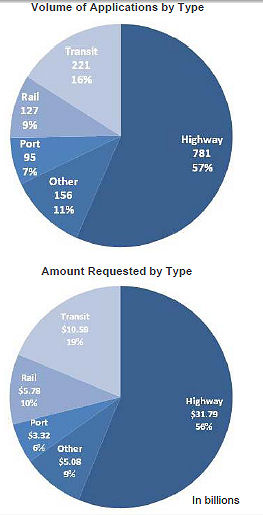
The ports took to heart the Secretary’s encouragement. He really wanted them to apply for grants and apply they did.  Ninety-five applications were submitted for port related projects totaling $3.3 Bn.  Certainly the smallest of the modal slices on the pie chart, but not an overwhelming difference when compared to rail.

Toward what end?  We’ll learn in February what projects are approved and how many are for ports.  The TIGER grants and pending legislation to grant MARAD infrastructure improvement authorities are signs that change may be in the wind.  The Feds are becoming more open to assisting ports with more than just channel construction and maintenance.  Certainly MARAD is eager to claim new program areas.  And some of the ports, perhaps an increasing number, are welcoming the help of Uncle Sam…maybe even inside the gate.   Pbea

The MPO Role in AMH

In Marine Highway on September 26, 2009 at 10:34 pm

NYMTC

The Marine Highway effort took a big step forward,maybe three years ago, when former MARAD Administrator Sean Connaughton traveled to Little Rock for the annual meeting of the Association of Metropolitan Planning Organizations.  MPOs are the regional transportation planning entities responsible for developing Transportation Improvement Plans and selecting projects for Federal funding.  They consist of local government and transportation agencies including State DOTs.  The interest that an MPO shows in freight transportation depends on how well ports and other freight stakeholders engage their local MPO.

Connaughton, a former county official in Virginia, understood the role of MPOs and the Federal resources they have to support projects.  He knew also that most MPOs understood little or nothing about short sea shipping or most any form of marine transportation.  If transportation planners were to give consideration to coastal or inland shipping in addressing transportation needs they would first have to know it exists…and is relevant.

When MARAD later issued for comment the interim final rule for the America’s Marine Highway (AMH) program the notice effectively alerted transportation agencies that a new program was to begin.  Input was invited for the naming of marine highway corridors.  The response has brought to light many projects and a level of interest that previously had not been known.  (MARAD is expected to issue final rules for the program later this year and formally solicit project proposals early next year.)  Enter NYMTC.

An effort is underway by planners in the New York Metro region to gauge interest in the budding marine highway program.  NYMTC, the New York City and Long Island MPO, has scheduled a meeting for September 29th.  (See the “downloadable files” on the left menu of NYMTC site and find “America’s Marine Highways” on drop-down list.)   All are welcome to participate and one can view the meeting online.

According to Howie Mann of NYMTC the agency has reached out to neighboring MPOs–an important step because marine highway corridors inevitably extend beyond the limits of one or more MPOs.  Like the 64 Express project on the James River, undertaken by Barbara Nelson of the Richmond Regional Planning District Commission since that Little Rock meeting, these steps by NYMTC will add to public and institutional understanding and should prove useful.

Note:  If you are curious to know more about reginoal transportation planning and the MPO role, here is a worthwhile read about The History of Metropolitan Planning Organizations.   Pbea

Rendell Bets on a Delay

In Infrastructure, Surface Transportation Policy on September 25, 2009 at 7:44 am

Governor Ed Rendell, a leading figure in the call for infrastructure reform and investment in the U.S., said that any surface transportation bill that Congress could pass this year would be a “very mediocre bill in terms of the needs of the country.”

In a story yesterday by Bob Edmonson of the Journal of Commerce the governor acknowledged, “In one sense a delay is hurtful, but in another sense the delay would give us a chance to look at new ideas, and build new concepts, and try to get a bill that will really revolutionize.”  Rendell spoke at a American Road and Transportation Builders Association conference.

The governor apparently assumes that the Senate and Administration will succeed in getting an 18 month extension of  the expiring SAFETEA-LU.  Chairman Jim Oberstar (D-MN) on the House side doesn’t want to put off major revenue and policy decisions that long.

On September 23rd when the House debated, and passed, a three month extension, through December, Steven LaTourette (R-OH) agreed that action is needed now.  His House Republican leadership opted to object to a prospective gas tax hike, which was not even on the table, rather than identify themselves with the need to maintain highway and transit programs.  LaTourette stood in the well–exasperated, looking at his own party members–and said, “I am constantly amazed at how both parties are able to snatch defeat from the jaws of victory.”  He foresees his party in the months ahead fighting a major transportation bill in the cause for low taxes.

In a recession the desire to improve the economic environment for employment is genuine and politically vital.  It’s easy to understand the impatience.  Oberstar and others want to move as quickly as possible to produce a 5-year, $450 Bn transportation bill.   Then again, there is that knotty problem of how to pay for it, as noted in this prior posting.

Whatever other thinking may be behind Governor Rendell’s frank remarks to the “road builders” he makes an important point.  On the surface is this one:  Jim Oberstar may be ready to move a bill but the Senate and administration are not.  But Rendell seems to go deeper than that.  Crafting a major bill, with its inherently difficult revenue issues and bearing the weight of expectations that this one must break new policy ground, will take more time.

Rendell is right.  After reaching the pinnacle that is SAFETEA-LU we don’t need another “mediocre” bill.   The hearing record of recent years is loaded with testimony calling on Congress to not repeat past mistakes and, as the governor put it, to produce “a bill that will really revolutionize.”  Freight policy, high-speed rail, transportation policy in a new energy/environment policy framework, performance measures, marine highways, livable communities, and the broader question raised by the Secretary as to how to integrate the MTS more fully into surface transportation policy.  These are just some of the policy challenges.

The Oberstar bill is a clear step in that direction.  And while the Senate committees have been plotting their TEA contributions the administration can’t say the same.  The White House and the Department of Transportation, which remains immersed in implementing the economic stimulus package with its multi-billion dollar new programs,  are nowhere near ready to be a full participant in the crucial dialogue on next generation surface transportation program and policy.  It will take more time.   Pbea