Marine Transportation System

Posts Tagged ‘USDOT’

A Million Reasons

In Leadership, Surface Transportation Policy on September 21, 2009 at 12:26 pm

TollBanana

“Funding is the key,” said former DOT Secretary Norman Mineta.  He should know.

Mineta spoke to an estimable eighty invited to UVA’s Miller Center of Public Affairs to discuss how significant reform in surface transportation policy might be achieved.  He told them that funding is the prerequisite for the kind of major investment measure that all agreed is needed.

Noting the particular challenge, Mineta recalled how he  brought to the Bush (43) White House a proposal to add two cents to the Federal fuel tax.  The intent was to elevate road and transit program funding to level closer to actual system need.  The Commander-in-Chief said no.

Pop Quiz:

  1. On what bill did George W. Bush first exercise his power of the veto?  (Softball.)
  2. Aside from a $8 Bn game-changing plan to jump-start high-speed passenger rail, which president ruled out any immediate action on a major transportation infrastructure program because he (that’s a hint) was not inclined toward a tax hike or other revenue measure? (But why just pick on presidents?)
  3. Is there a snowball’s chance in Haiti that Congress will pass the next full-fledged TEA bill anytime soon?

(Answers: SAFETEA-LU, Obama, Not likely.)

It’s not a stretch to suggest that it may take years for official Washington to approve a costly multi-year surface transportation bill.  Certainly one that includes substantial reform  (such as sustainable transportation and livable communities), new attention to freight gateways and corridors, and overall higher levels of capital investment in our declining public works.  Hundreds of billions are needed over and above what is required to maintain what we already have.  And a declining highway trust fund makes even maintaining the status quo a pressing challenge.

Josh Vorhees of Energy & Environment News wrote a good story carried by the NYT.  The conferees at UVA know the timidity of the Electeds when it comes to approving new revenue increments to support this or that.  When it comes to the partisan battlefield there is no distinguishing a user fee from a tax.

Some time ago, when a toll increase was being contemplated by staff of  a public authority, the subject was referred to as “The Banana. ”  The T-word was not uttered in internal discussions–lest others outside the agency get wind of it before the numbers were fully crunched and the rationale fully developed.  “The Banana” was a calculated, albeit humorous, way to manage in the hyper-sensitive political world.

A some point–much sooner than later–the million reasons why a tax payer or system user should not be charged must be faced by our Electeds.  At some point the fact will sink in that America’s competitiveness is declining as other nations  are  using this lousy global recession as reason to engage in major infrastructure improvements.

Mort Downey recounted last week at a freight-related event how over the years Washington has managed to extend or raise the vehicle fuel tax even when the economy was in distress.  Somehow we survived.   Pbea
Report on Freight Funding Policy

In Federal Government, Infrastructure on September 2, 2009 at 4:50 pm

The TRB has a new report that is worth a look:  Funding Options for Freight Transportation Projects. The study committee was charged with examining the rationale for public investment, evaluating financing strategies for “freight transportation projects of national significance,” assessing the ability to use criteria  in project selection,  and evaluating and comparing “generic financing options…based upon the greatest net benefit and least cost per public dollar invested.”  Here is a summary of the broad categories of recommendations along with a sampling of specifics:

  • Federal freight infrastructure assistance programs should adhere to certain guidelines. Project earmarking “weakens the effectiveness” of programs; any program should be structured to address freight projects on a case-by-case basis and be “flexible to address diverse assistance needs.”
  • Create a new discretionary assistance program to support freight projects, starting with a “test of the need for and value of a responsible and flexible federal program…” The “test” would be $1.8bn over 4-6 years and an independent evaluation to determine the program’s worth.  Note: the program outlined in the report is in many ways similar to the multimodal “TIGER” grants USDOT was charged with administering in the economic stimulus bill enacted last February.  Applications are due Sep15 and selected projects announced in Feb.
  • Make credit assistance more accessible and attractive to freight projects that merit Federal support. Includes revisions to TIFIA; encourage private sector participation by changing tax laws to be “neutral with respect to private versus public management” and finance “the kinds of facilities that commonly are built by the public sector.”
  • Reduce barriers to the development of local and facility-specific revenue sources to pay for freight infrastructure capital costs and provide incentives to encourage use of such sources. Enable port authorities to impose cargo charges “for purposes of  providing revenue for construction and operation of port facilities and access routes…”; reduce barriers to foreign ownership, operation and investment in the transportation industry, “particularly maritime and aviation…”
  • Expand the capability for freight system planning, project evaluation and data collection. Establish a “discrete…home for the functions of project evaluation, performance monitoring and technical assistance to state and local governments;”  develop a “continuing, comprehensive, and systematic program to monitory performance of the national freight transportation system…”

Walking the Dock and Talking the Talk

In Federal Government on August 16, 2009 at 9:19 pm

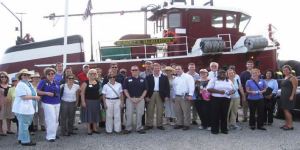
CMTS group

This week Federal agency folks caught the bus to Baltimore to see a port.   It was organized by Helen Brohl and staff of  the Committee on the Marine Transportation System (CMTS) and facilitated by Frank Hamons and colleagues of the Maryland Port Administration.  The civil servants from NTSB, ITA, OMB, MARAD, NOAA, USACE, USCG, EPA and  perhaps other offices and agencies left Washington to see elments of the MTS first hand.

Terminal operations, a NOAA survey vessel, a Ready Reserve Force ship, an intermodal yard, and a tugboat tour of the cargo and quiche sides of the waterfront.   They met with public and private sector people who keep the working port working.

From time to time one reads complaints about taxpayer money spent on public employee field trips and conference-going…as if it’s always a pleasure jaunt and never of professional value.  I’m sure that this same-day hop, just an hour up the parkway, will spark no such carping.  But that’s beside the point.  It’s a fact that trips like this one  to  the Maryland port instill more understanding than does the reading of a report.  Even one with lots of pictures.   When one is in the field the senses absorb.  The mind muses.   The discussion flows.

Washington is paying much more attention than ever to ports, shipping, and our system of logistics.   EPA regulates ballast water.   The Corps maintains channels.  TSA checks dock worker backgrounds.  NOAA decides when the dredges can work.  OSHA sets new container lift standards.   The Senate ratifies standards to lower ship emissions.  CBP scans cargo for radiation.   OMB reviews regs and budgets.  Fees are collected and new fee proposals abound.

Taking one day to take in the context for all of the above is a day and money well spent.  Kudos to CMTS and the folks in the picture.   Pbea

Bill Sez “Nah” to Funding Ports/Freight with NII

In Federal Government on August 4, 2009 at 11:29 pm

Interesting.  When in February Congress sent the huge economic recovery package a.k.a. ARRA, to the White House for signature many folks were pleased that it contained a new $1.5bn multimodal discretionary grant program for the  Transportation Secretary to allocate.  House and Senate appropriators are not known for giving department chiefs  large sums  of money to spend on this or that.  Nor has Congress been in the habit of allowing the Office of the Secretary (OST) the discretion to grant funds outside the tightly prescribed modal grant programs and, for that matter, for projects not already earmarked.  So, when the authority to spend $1.5bn was sent to Secretary Ray LaHood  observers knew much was at stake.  Might this open the door to additional multimodal appropriations or to a new program that would be included in the eventual successor to SAFETEA-LU?

Just a few months later we have a partial answer.  Senate Appropriators included in the FY 2010 DOT spending bill (HR 3288) yet another, but not identical, multimodal discretionary grant program.  This time it is $1.1bn for National Infrastructure Investments (NII).  It seems to resemble the $1.5bn pot that Secretary LaHood has dubbed TIGER grants–applications for which are due at USDOT September 15th.  The Senate committee summary indicates the grants are “to support significant transportation projects in a wide variety of modes, including highways and bridges, public transportation, passenger and freight railroads, and port infrastructure.”   But according to Jeff Davis of the very reliable Transportation Weekly the intent is not to support certain port and freight related projects that are outside of the Title 23 (highways, etc) and Title 49 (transit) eligible project categories.  Jeff says it does not include this TIGER grant language from the stimulus bill that opened the door to “port infrastructure investments, including projects that connect ports to other modes of transportation and improve the efficiency of freight movement.

Wading in more deeply…here is where it is a bit confusing.  Title 23 eligible projects do include some freight related projects such as “intermodal transfer” and “public freight rail” facilities. As for ports  Title 23  even includes (but limit  eligibility to) certain projects within a port terminal’s gate that facilitate the “direct intermodal interchange, transfer and access” in and out of the port.  So how does that differ from the underlined above?   Maybe the answer is somewhere in this supplemental description of the TIGER grant program that would invite, for example, vessel projects that otherwise meet TIGER grant criteria.

So, why NII and not TIGER II?  Could this represent some disapproval of  the Secretary’s recent encouraging words to the effect that TIGER grants enable a change in policy that to date has offered port/maritime related infrastructure little or no Federal program assistance?  Let’s hope not.  More to learn.

Transformational Transportation, Part 2

In Green Transportation on July 31, 2009 at 11:21 pm

Persons famliar with Secretary LaHood’s meeting with public and port officials in Oakland tell me that folks might be surprised to know which California official was most enthusiastic  about the prospects for Bay Area marine highway service.  Among those at the meeting were two California cabinet members (Food & Agriculture and Business, Transportation & Housing) and the director of Caltrans.

The Eco Transport project has been in development for a few years.  The business plan is to reduce the need for  truck moves into Oakland by deploying barges to move containers between Oakland and the Ports of Stockton, initially, and Sacramento.  The company notes that such an operation also will make unnecessary a great many empty container moves and the associated costs of fuel and exhaust.   Export containers could be loaded heavier in Stockton because they would not have to meet road weight restrictions.  And carbon counters are sure to like the shrinking of the significant carbon footprint of trucks carrying imports into the central region, and California exports to Northern California’s principal international gateway.  Indeed the company has done its due diligence to substantiate the environmental benefits of their new marine highway service.  And the result has been the endorsement of regional and State air quality agencies.

So which official at the meeting revealed great eagerness and anticipation about the green barge service?  It was Food and Agriculture Secretary A.G. Kawamura.  He and the growers/shippers of the Central Valley are enthusiastic about the prospects for barges carrying goods to Oakland and then on to a ship for the export market.  And when a shipper is looking forward to taking  its goods to the water that’s a very encouraging sign.

LaHood: Marine Highway as Transformational

In Ports on July 27, 2009 at 2:24 pm

DOT Secretary Ray LaHood was in Oakland on July 2nd talking freight and ports.  He was importuned by local, State and Federal office holders about the need for a national goods movement policy.  He was told that infrastructure improvements strengthen the capacity of ports to serve the nation.  He  heard them say there’s a need for equity among West Coast ports.   He volunteered that a California “ports czar” might be what’s needed.  (Although that may not be what the folks in Oakland have in mind.)

He also reiterated his view that marine highway development should be realized and would be “transformational.”  His tweet from Oakland: “US ports provide transportation for the 21st century.”

The key to creating more environmentally friendly ports, LaHood said, is to transport more goods by ship rather than trucks. He mentioned, in particular, the importance of a “marine highway” along the West Coast. “We will be putting a good deal of emphasis on the marine highway in order for us to get trucks off the road and get cleaner air,” LaHood said. (Source: Chris Metinko, Oakland Tribune)

MTSNAC Today…and Tomorrow?

In Federal Government on July 22, 2009 at 1:02 pm

The Marine Transportation System National Advisory Council was established in May 2000 to serve and advise the Secretary of Transportation.  Its public and private sector stakeholder members have, for the most part, served three year terms.  (This writer served a term on the council and remains involved.)

The MTSNAC was there in 2001 to provide guidance to the Secretary on the very practical considerations pertaining to cargo flow when the Feds stood up security measures and new law after the Towers fell.  It prepared instructive presentations on global logistics with the intent to explain a little understood system to Washington policy makers.   It produced recommendations for the Secretary as to how new government policies and private sector actions can result in greater efficiency to goods movement.

This year the future of MTSNAC is under consideration.  Will it be extended beyond 2009?  Will it be reconstituted with changes?  Will it be terminated?  Those are options that have been suggested by various parties at USDOT.  The thinking in the Secretary’s Office on this may become known this week when MTSNAC meets here in Washington.  Perhaps its last meeting.

This much is evident.  Goods movement and the global supply chain are playing increasingly significant roles in the U.S. economy and have exposed where our national transportation system, including the MTS, warrants improvement and high level attention.  As such the leadership of USDOT would continue to benefit by having an advisory panel whose members include the non-Federal agencies and industries that are stewards, service providers and users of the marine transportation system.   Pbea